I’ve been a huge fan of keeping a food and exercise log/journal since I first started to dip my toes into the health and fitness arena. I call it “tracking,” largely because that’s how my Weight Watchers peeps refer to it. Yes, it’s kind of a pain in the butt sometimes, and I’m not 100% compliant with my own goal of tracking every day, but in my experience it’s been a huge help. When I write it down, I stick to my plans. I tend to eat healthier (because who wants to write down, “Ben & Jerry’s Chubby Hubby, 1 pint”??). I tend to workout more because I can see lots of blank space when I haven’t been exercising.

There are many electronic options to track, including free and paid apps and websites where you can track both exercise and food (e.g. My Fitness Pal, Livestrong, FitBit) but I do best when I write things down. For one, I spend so much time on my phone and computer that I don’t really need to find another reason to do that. For two, when I’m using pen and paper it’s easy to track what I had planned versus what I actually did. Or doodle in the margins. Or reward myself with a cool gel pen with funky ink. Finally, I’m more like to review my data if I can thumb through the pages and compare multiple pages at once.

So you might wonder, why bother with tracking? Trust me, it’s not just my personal obsession.

Three reasons you might track

1. Lose Weight

My first experience with tracking was actually when my office started a Weight Watchers group. As part of the program, we kept track of what we ate each day, working to stay within our “points” allowance. Tracking to lose weight is a proven method for adherence to a weight loss program.A study called Long Term Weight Loss Maintenance indicates tracking is also useful for maintenance, noting that some of the factors for long-term success (taken from the National Weight Loss Registry data) include “self-monitoring weight, and maintaining a consistent eating pattern across weekdays and weekends.” (You can read the rest of the abstract for more.)
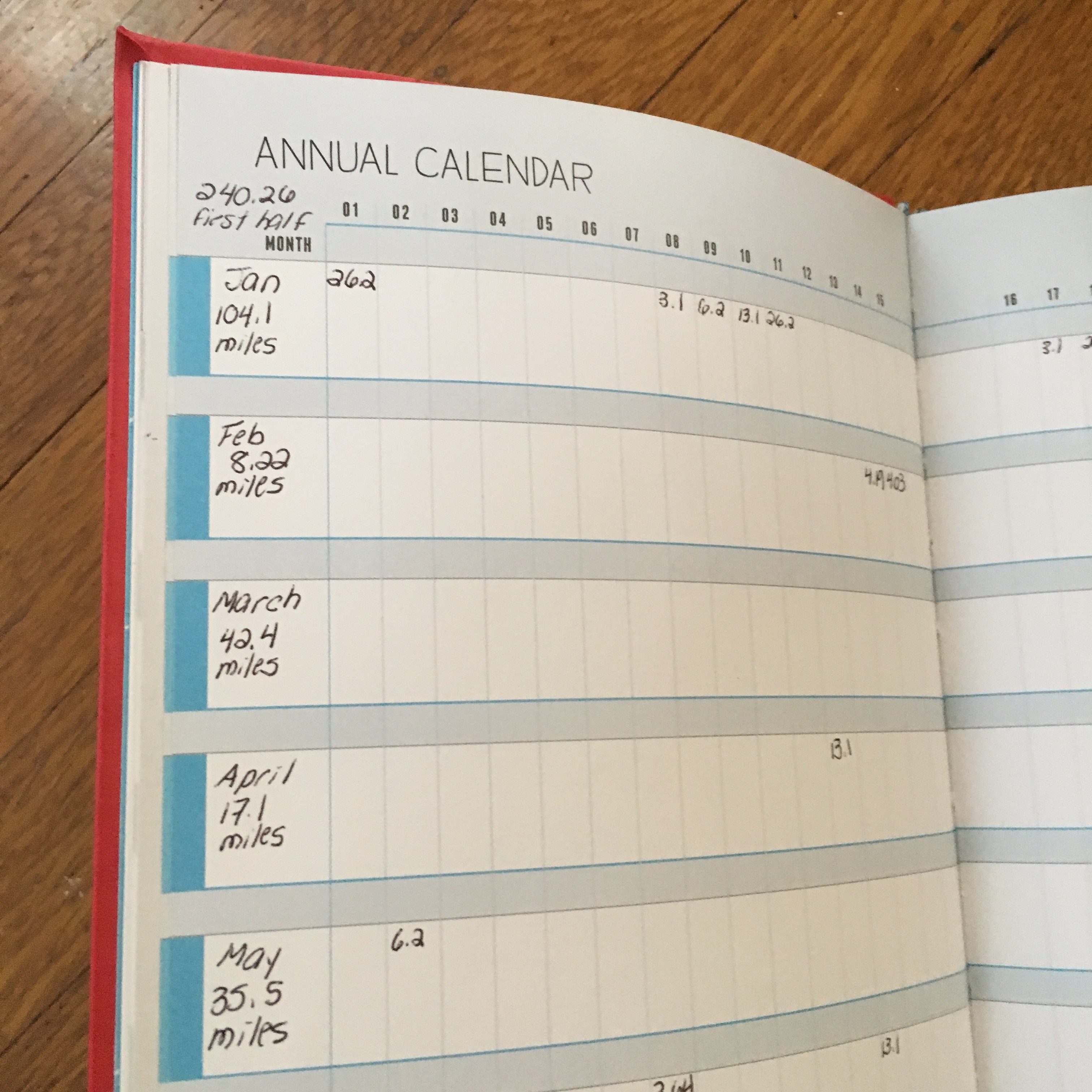
Mileage Data (Believe Journal)

2. Collect Data

If you’re tracking food intake, you probably know to write down what you ate. Don’t forget to write down how much! You might also write down how you felt afterwards. (I know people who have discovered food sensitivities this way.) Food is really tied up in emotions, and you might discover you’re eating because you are upset or bored!

If you’re tracking workout data, what you track probably depends on what you’re doing. In the P90X programs, Tony Horton recommends writing down how many reps you got through of each exercise (in addition to how much weight you used). If you’re running, you probably want to track time and distance, but you might also want to track weather, road conditions, and other factors that could affect your run.

Tracking both food and exercise allows you to see whether there are correlations (I always run better after a half cup of coffee, I’m miserable if I had champagne the night before), or if you’ve fallen into a habit you’d like to keep up or break up with. Right now I’m also tracking my water intake and hours of sleep.

If you’re really into the idea of collecting up data, you might want to check out the Quantified Self movement and see if there is a meet-up or conference near you.
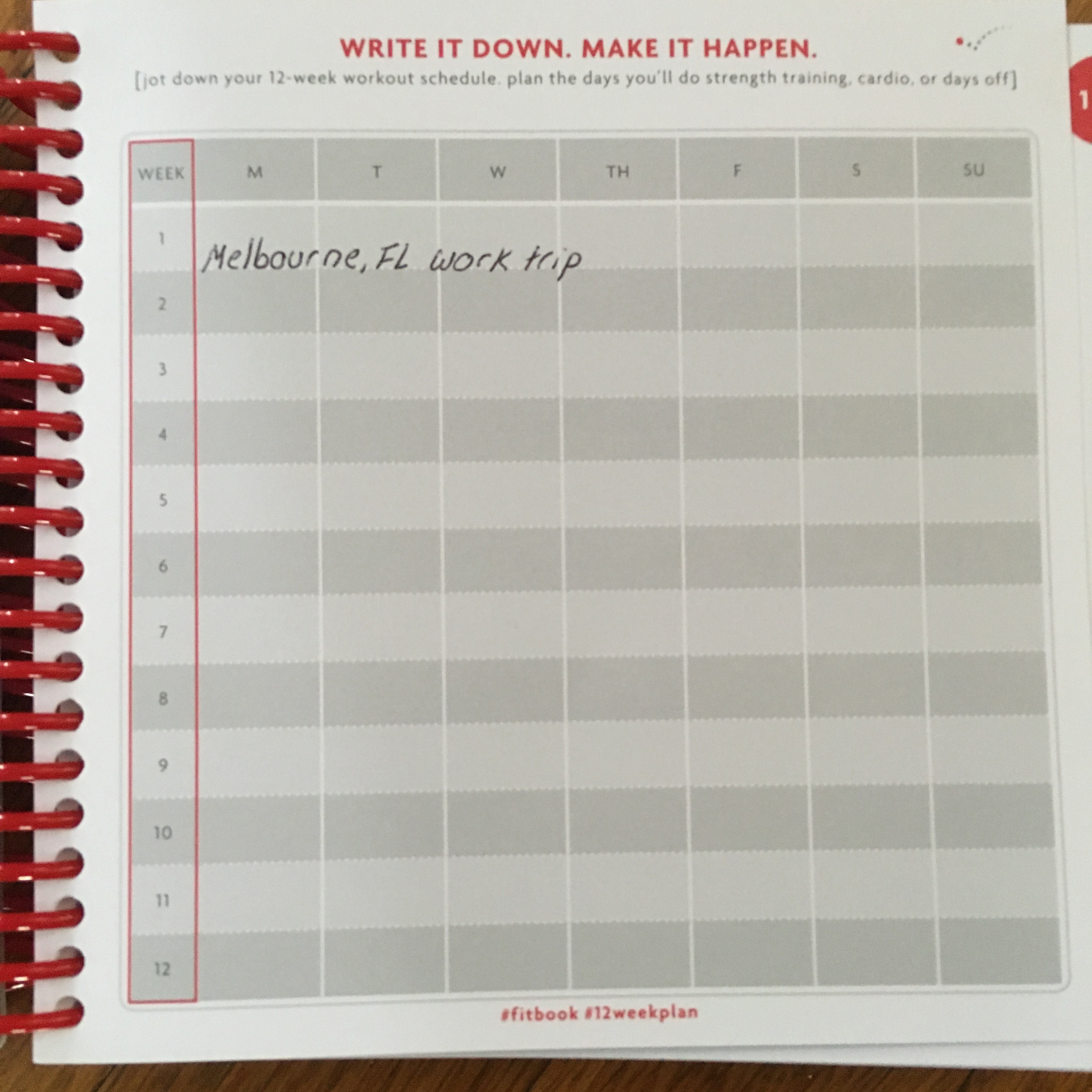
The big picture page (FitBook)

3. Plan Ahead

If you are training for an event, you probably have some kind of training plan. Runners often plan a certain number of miles or minutes per training day. But planning isn’t just for “those people” (if you’re not one of them!). Maybe you need to plan out your workouts because you’ve got a busy schedule and a full plate, and planning it out ensures it will happen. You could put the workout in your regular calendar like an appointment, then write out the details in your tracker. If you’re following a training plan from a book or magazine, you can pre-write your workout in your tracker. I find carrying my small FitBook much more convenient than bringing the magazine, and I can always note where I made changes or did more reps. Another example, you can use a tracker to plan meals for you or your family (and from that, create your grocery list!). It can save you a bunch of time and money if you plan your meals that way.

Trackers I have known and loved

First, true confession, I’m actually tracking different things in different places. I have a FitBook for food and workouts. I have the Believe Journal for running, where I also write about how the run felt, what I got right and wrong, and my general thoughts about events, etc. I track my weight in the FitBit app. It might seem horribly inefficient to have all this data in different places, but it works for me–I want the graph the FitBit app makes, but I want space to write about my runs. I use the food section of FitBook to track container equivalents from the 21-Day Fix eating plan, but formerly used it to track points.

While you can just grab any notebook and start your own tracker, I’ve not have great success with this. The main issue for me is that since the pages are not organized into days and weeks, it is just too easy to skip a day, and “just for today” turns into “I don’t track anymore.” When I first started tracking I wasn’t sure what I wanted to track, and I tried to do too much, which also made the blank notebooks less than effective. I enjoy the graphic elements of the published trackers as well.
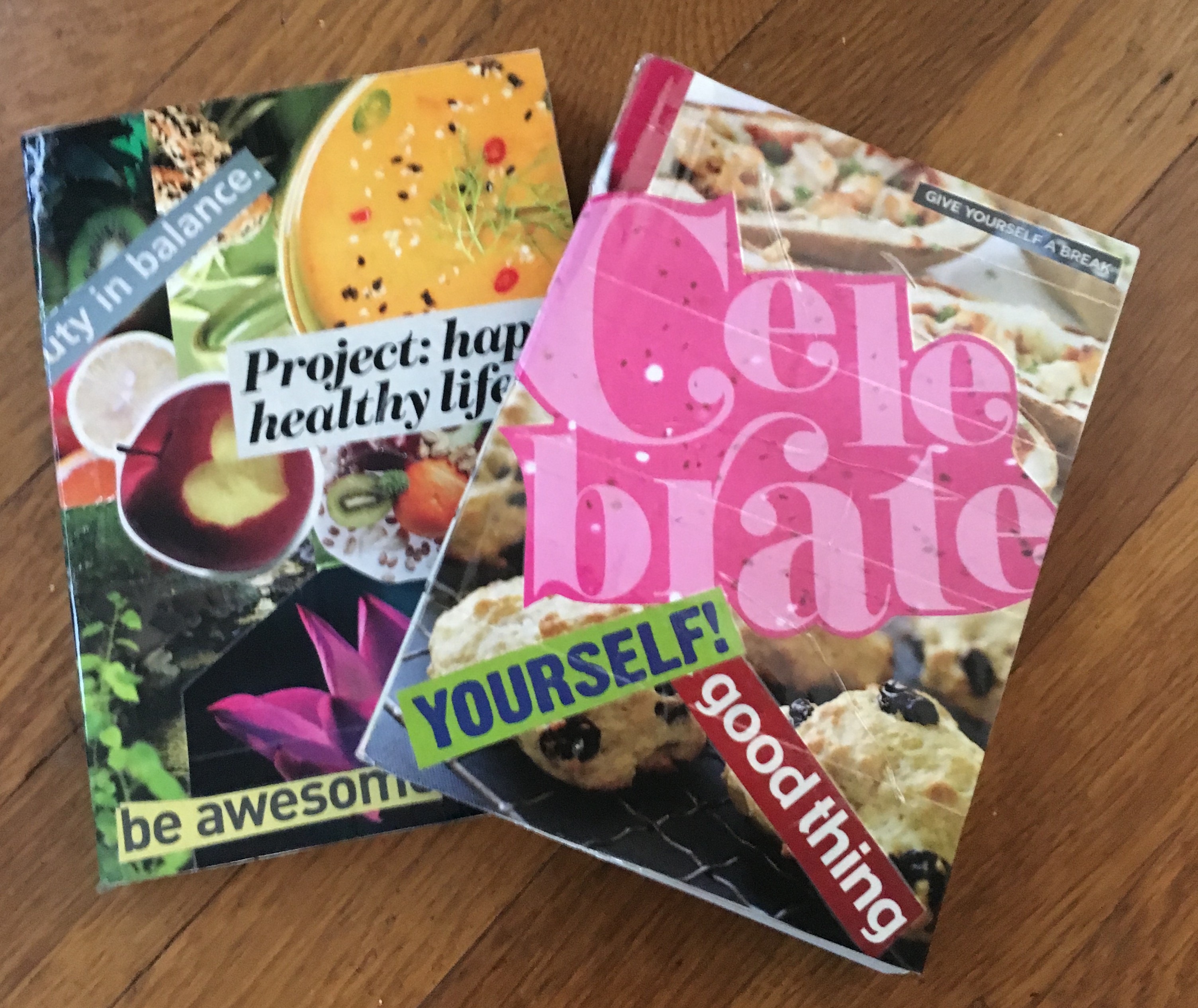
An example of my inspiration collages

Weight Watchers

There is a WeWa app now, and some of my friends love it. I’ve never tried it, in part because I found the website quite buggy when I tried to use it to track. Instead, I used the spiral-bound purse-sized trackers. Note that there is a free downloadable tracker, and those attending meetings can pick up single-week trackers (or used to be able to do so–I’ve not checking up on it lately). The link leads to the current journal, which is a 12-week hardcover, because I couldn’t find the spiral-bound one online. Pros: highly portable, used the covers for inspiration collages. Cons: not much room to track exercise, frequently ran out of room to write.
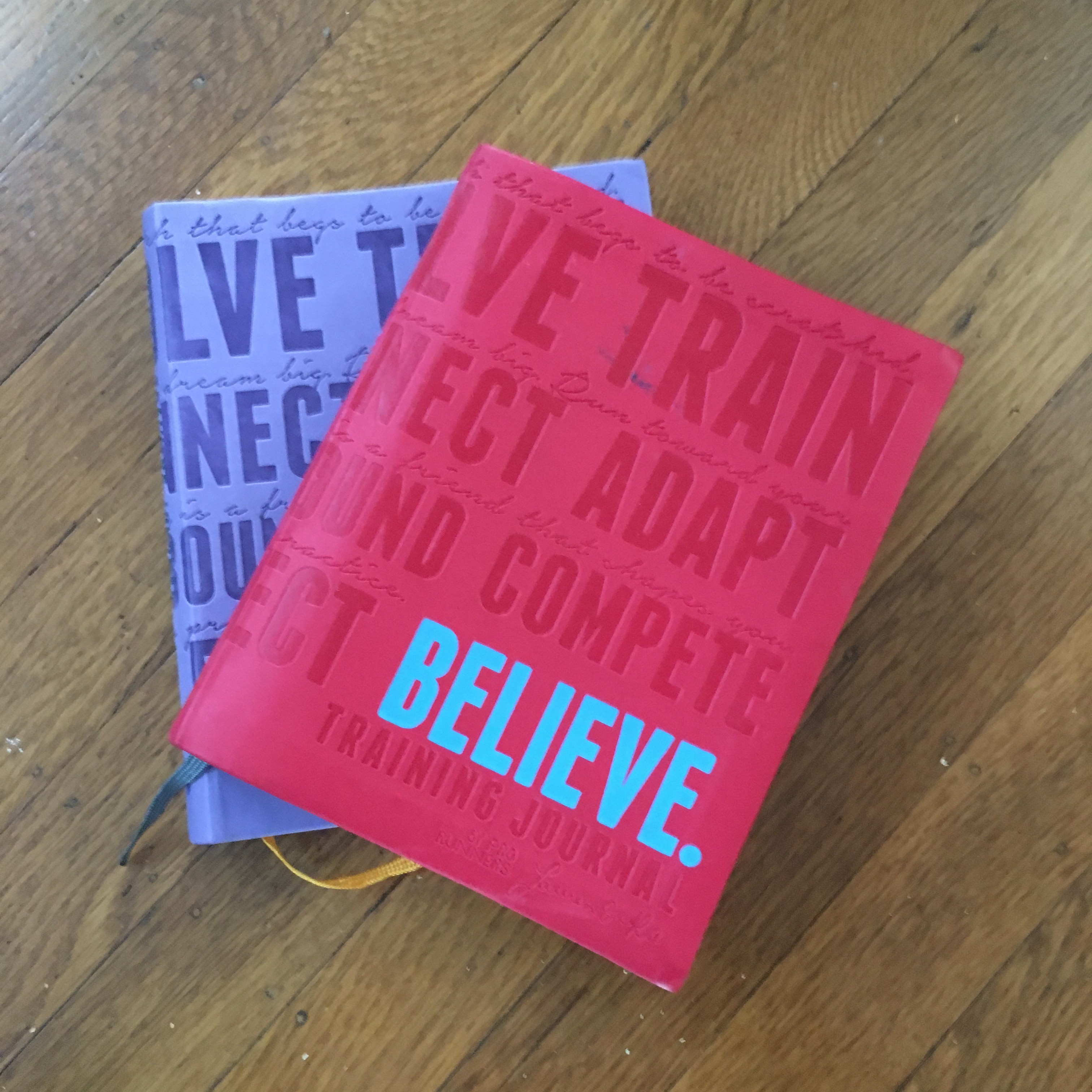
Red for 2015; Lavender for 2016!

Believe Journal

This is a running-specific journal, with information, inspiration, and worksheet-like activities between the regular weekly tracking pages. It was created by professional runners Lauren Fleshman and Roisin McGettigan-Dumas. You don’t have to be a runner to use it though–you could use the weekly pages for any activity, the yearly overview for planning, and the worksheets apply to almost every sport. There are some runner-specific information sections that don’t cross-apply though, including a variety of speed workouts, pace charts, and training plans.  Pros: plenty of room to write, spaces are customizable, textured cover, knowledge bombs/content. Cons: too large to carry around in a purse, not designed to track both exercise and food.
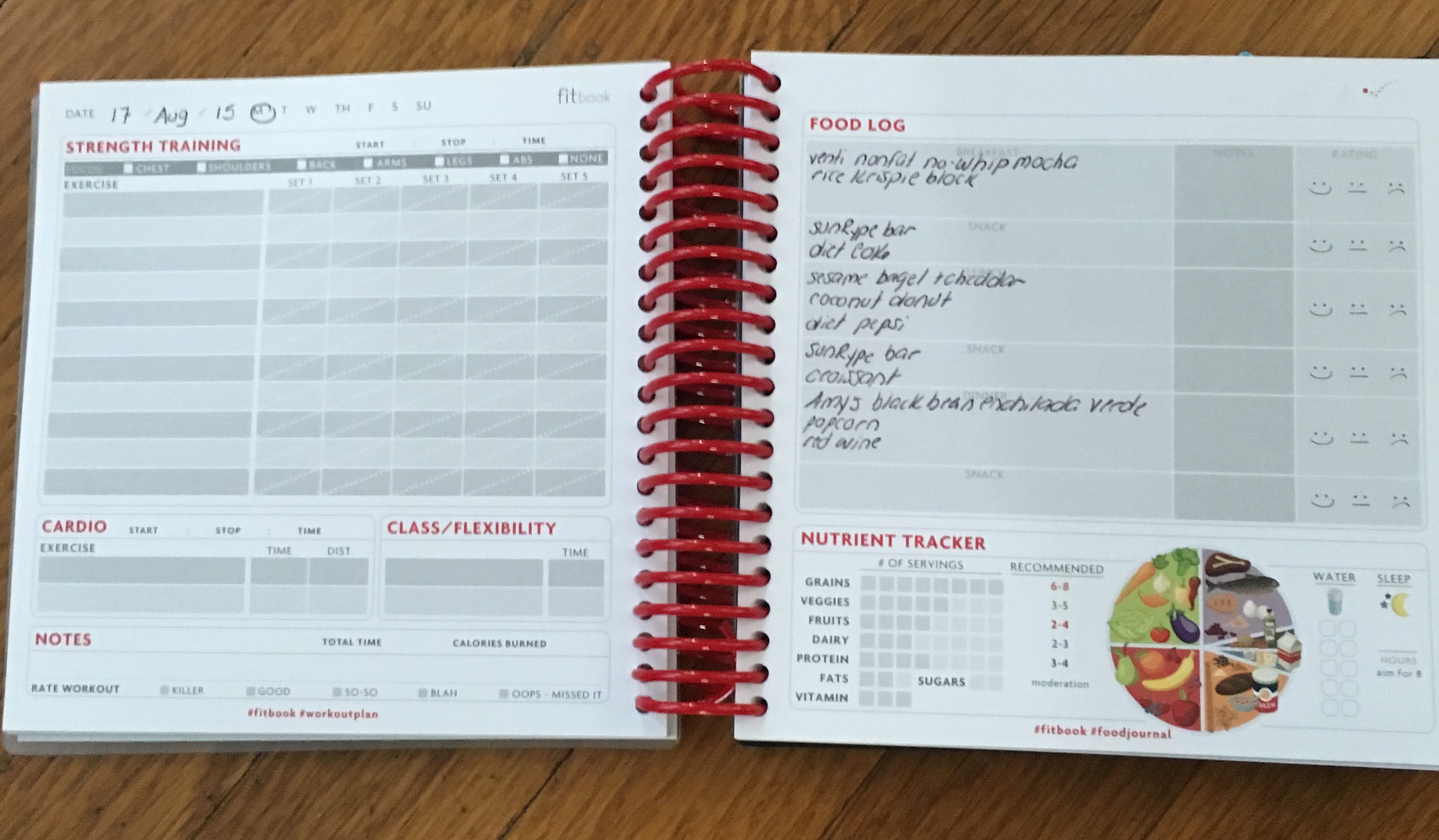
Workouts on the left, foods on the right
FitBook: Workouts on the left, foods on the right

FitBook

I first met FitBook at IDEA World in…wow, 2010. FitBook had a table at the expo, and I was so excited at how much better the format would be for my purposes. FitBook has a place to record stats other than weight, a weekly planning page, and a weekly summary page with space to journal, reflect on the week and how to move forward. There are two daily pages; the left side is for exercise and the right side is for food. The FitBook website and email newsletter deliver some great content for free, including inspiration, receipts, and printable calendars and goals worksheets. Pros: lots of space to track both food and exercise, largely blank areas are highly customizable, spiral binding lays flat for easy use. Cons: some might find it too big to carry daily.

A giveaway!
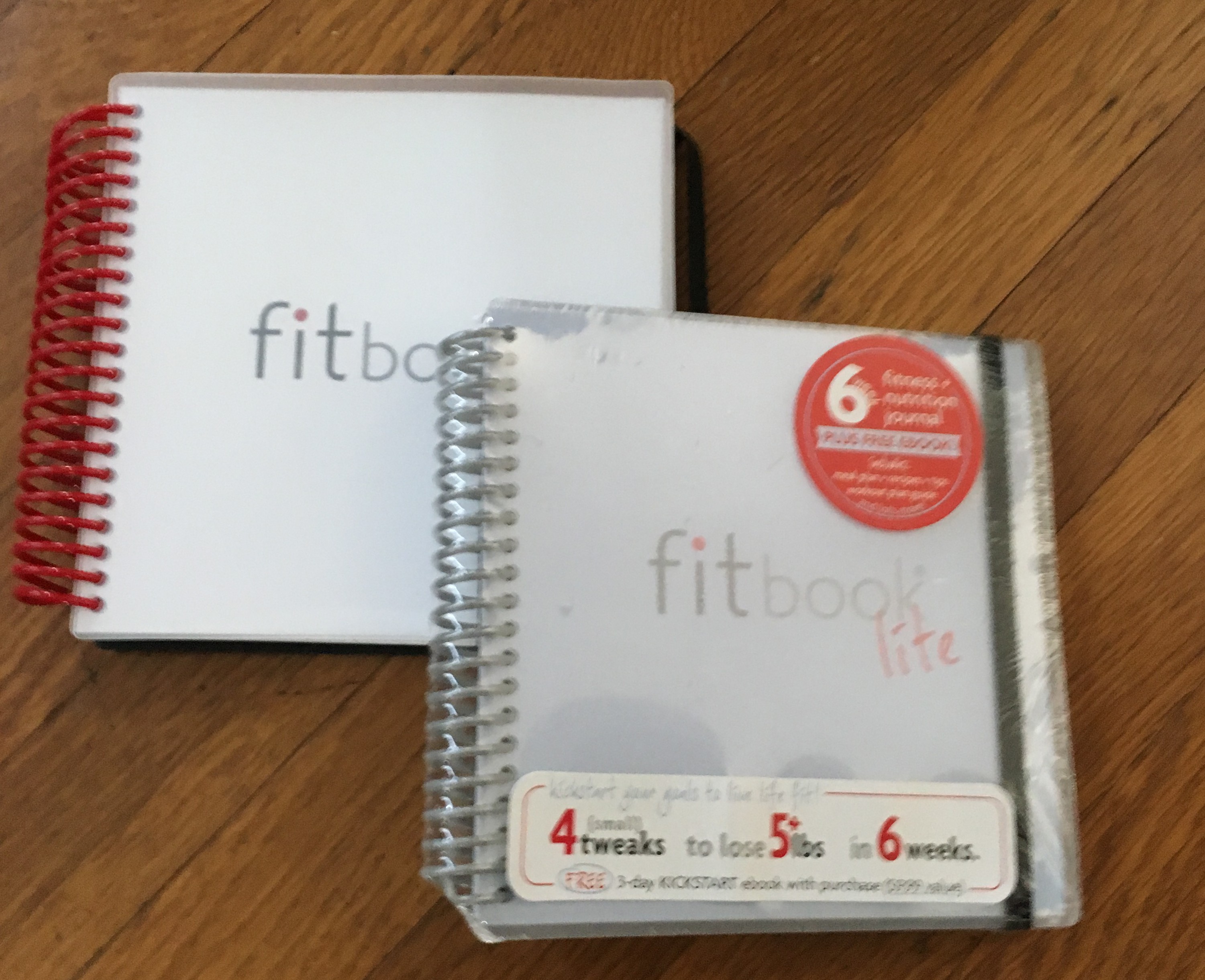
FitBook and FitBook Lite

I’ve got ONE brand new FitBook Lite! The “lite” version of FitBook is a six week version of it’s big sister, FitBook. Once you’ve got FitBook Lite in your hands, you can downdload a free kickstart ebook with a meal plan, recipes, tips, and a workout plan guide. Please note: this giveaway is not sponsored by FitBook (or anyone else) in any way.
a Rafflecopter giveaway

Disclosure: I received a complimentary bib to run The Double Your Luck Challenge because I am a BibRave Pro. Learn more about becoming a BibRave Pro here. Find and write race reviews at BibRave.com All opinions in this review are my own. (There is no “sponsored content” or advertorial here!)

BibRave Pros + Bling

While I originally planned to show up Friday night so I could check out the Sin City Shootout opening night parties after I picked up my packet, my elderly cat has been refusing to eat and is now on steroids…combine that with the week I was just out of town for the Walt Disney World Dopey Challenge, and I didn’t want to leave the poor meow alone for more than a night. So I flew in Saturday evening. While the Tropicana was the official host hotel for the Sin City events, I had a friend in town who already had a room at Harrah’s, and I love me some free crash space. The main advantage of packet pickup on Friday is the ability to purchase the special Sin City Shootout mug, which comes with a slew of drink specials at the various affiliated parties over the weekend. There was no pickup Saturday, and I wasn’t about to go out drinking the night before a race, so no parties for me!

I got up early Sunday and went down to hail a cab. The one thing I disliked about this event is that there was no transportation provided, and facebook group or other way to arrange a ride share. The Sin City Shootout host hotel is the Tropicana, though I stayed at nearby Harrah’s. My taxi out to the event cost around $30, and I wasn’t the only one who took a taxi—it would have been nice to have a way to coordinate rides. Some people did drive, but since I was just staying overnight the cost of a car rental was crazy. There was ample free parking right by the start/finish, so locals scored a great deal.

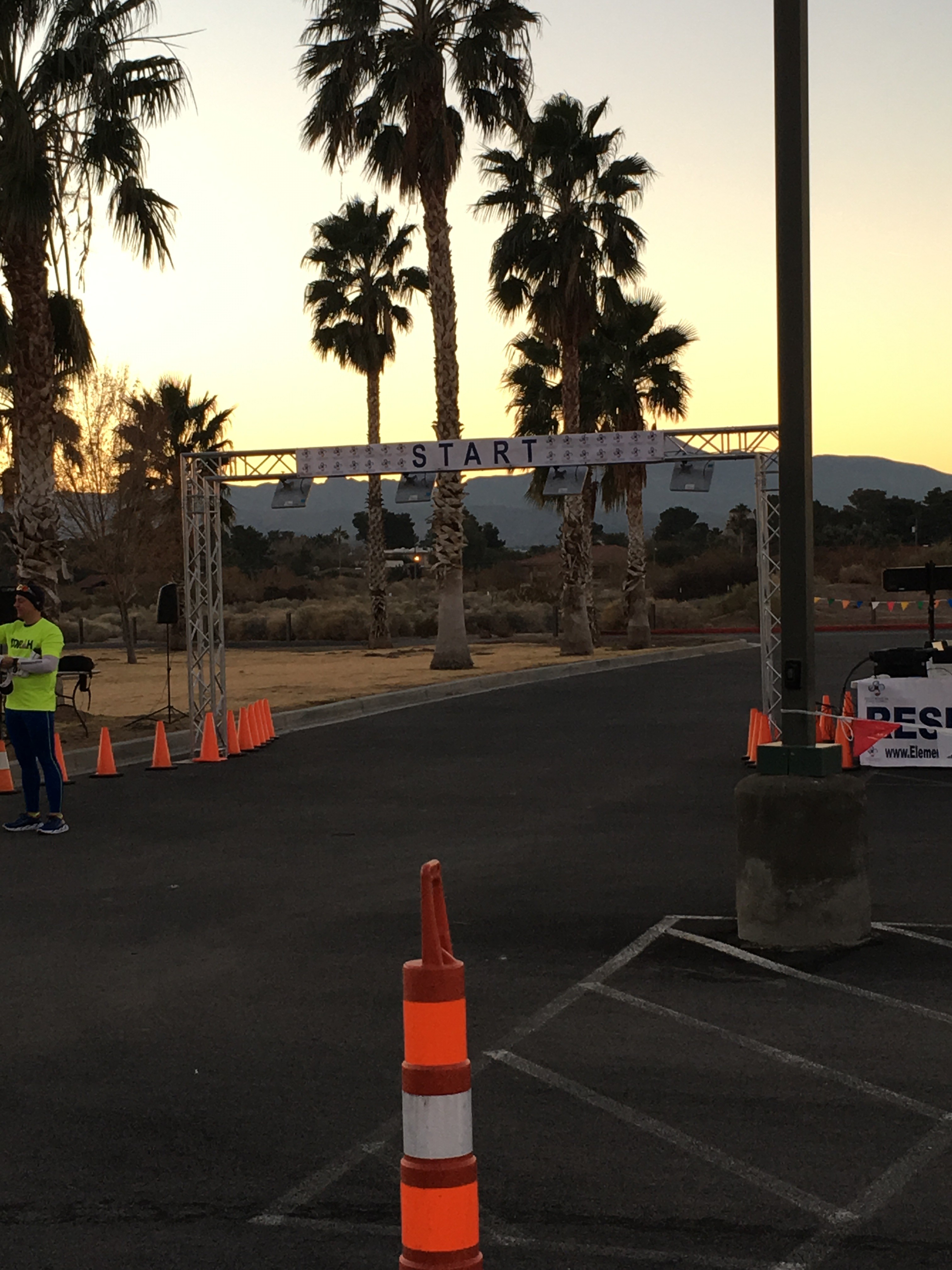
Start/Finish pre-race

While I had planned an hour before the race for packet pickup, I think it took more like 10 minutes. There was a line, but it moved rapidly. The Sin City Run packets were small but mighty! I really like it when a race packet has minimal paper (like flyers and stuff) and only runner-related items. Packets contained your race bib, a discount on EnergyBits, samples of gummy vitamins, Clif Bar minis, and samples of BioFreeze, in addition to safety pins. Unfortunately I didn’t get to pick up my shirt because two of the boxes of shirts were stuck on a UPS truck somewhere, so I’ll be getting mine in the mail. (They only had small, and I’m not small.) The shirts are cute, a grey basic cotton tee with the Sin City Run logo on the front. I know I’ll wear mine.

BibRave: #OrangeIsTheNewFast

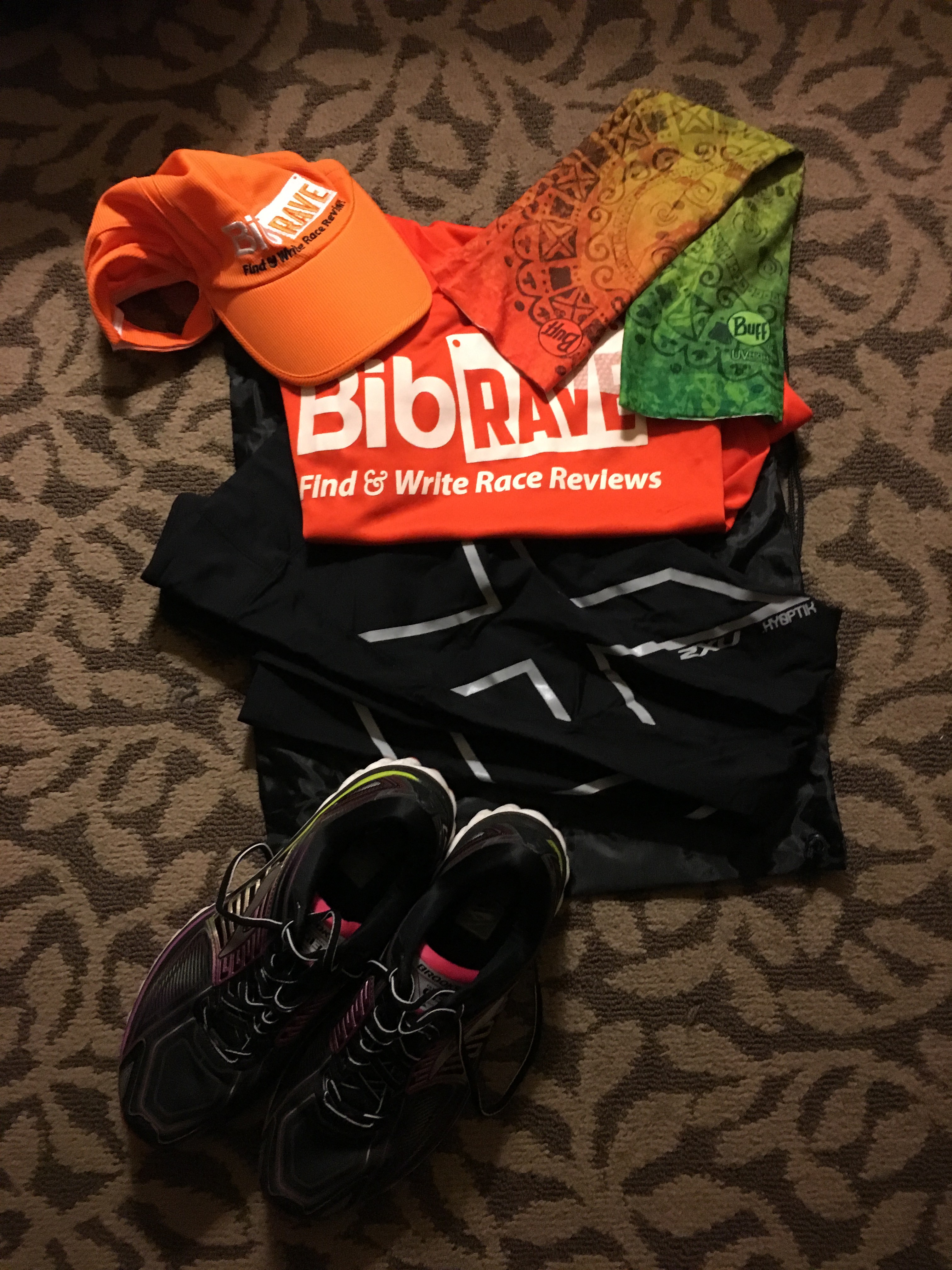
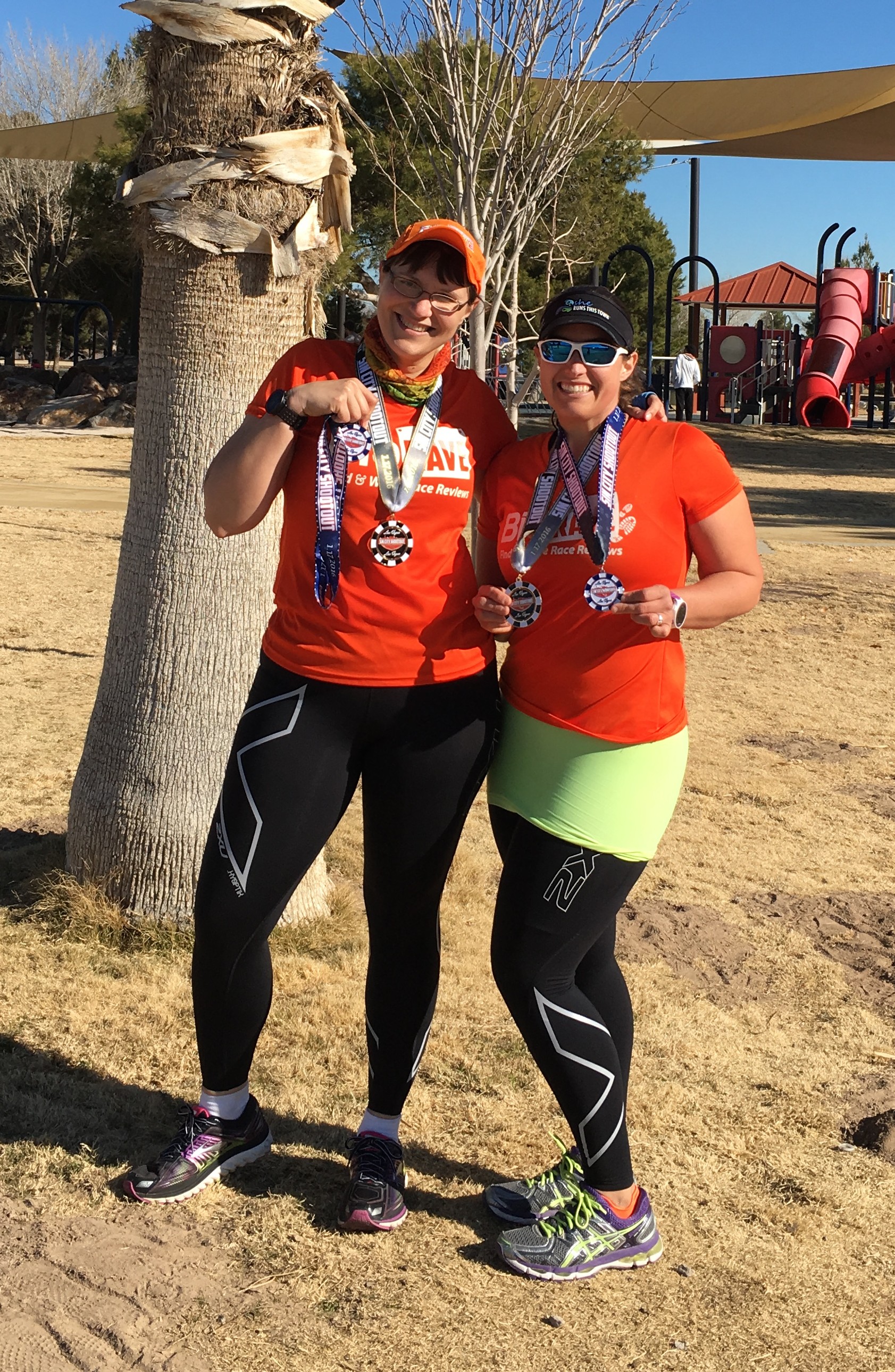
Initially, I was freezing cold—it was in the 40s, even though I’d checked the weather report and it said 60s!—and I really wished I’d brought a heat sheet or a long-sleeved shirt. Before the 5k, BibRave Pro Laurel (aka Running to Happiness) and I huddled in her car and had some BibRave Pro bonding time prior to the start. Both of us happened to wear our 2XU winter-weight Hyoptik compression tights, and I for one was VERY pleased for the warmth. For the 5k I pulled my Buff up like a balaclava to cover my neck and head, and give me a little extra heat-retention until the sun came out. Eventually the sun did come out, and I started to warm up quite a bit.

The course was flat and as I mentioned 100% blacktop. There was the most minor of downhills at one point in the course, but you really had to be paying attention to notice it. Both courses run through Sunset Park, a protected wildlife dune just past the airport. The 5k race course takes one loop around a portion of the blacktop-paved trails, and the 10k race takes that loop twice, plus a little mini-loop to add the mileage. (Given the layout of the trails, I suspect there were few options for adjusting the course length.)

For the 5k, I ran with Laurel. She was running 2-1 intervals at a pace of about 11 minutes/mile. (I think I remembered that right.) She was kind of kicking my butt, actually, but I wanted to try the 5k as a challenge. This seemed like a good idea for the first 2.6 miles or so, then I started lagging. Frankly, my legs were pretty leaden from last weekend’s running-of-the-Dopey. I made it anyway, of course, but my legs were very cranky.

IMG_3137
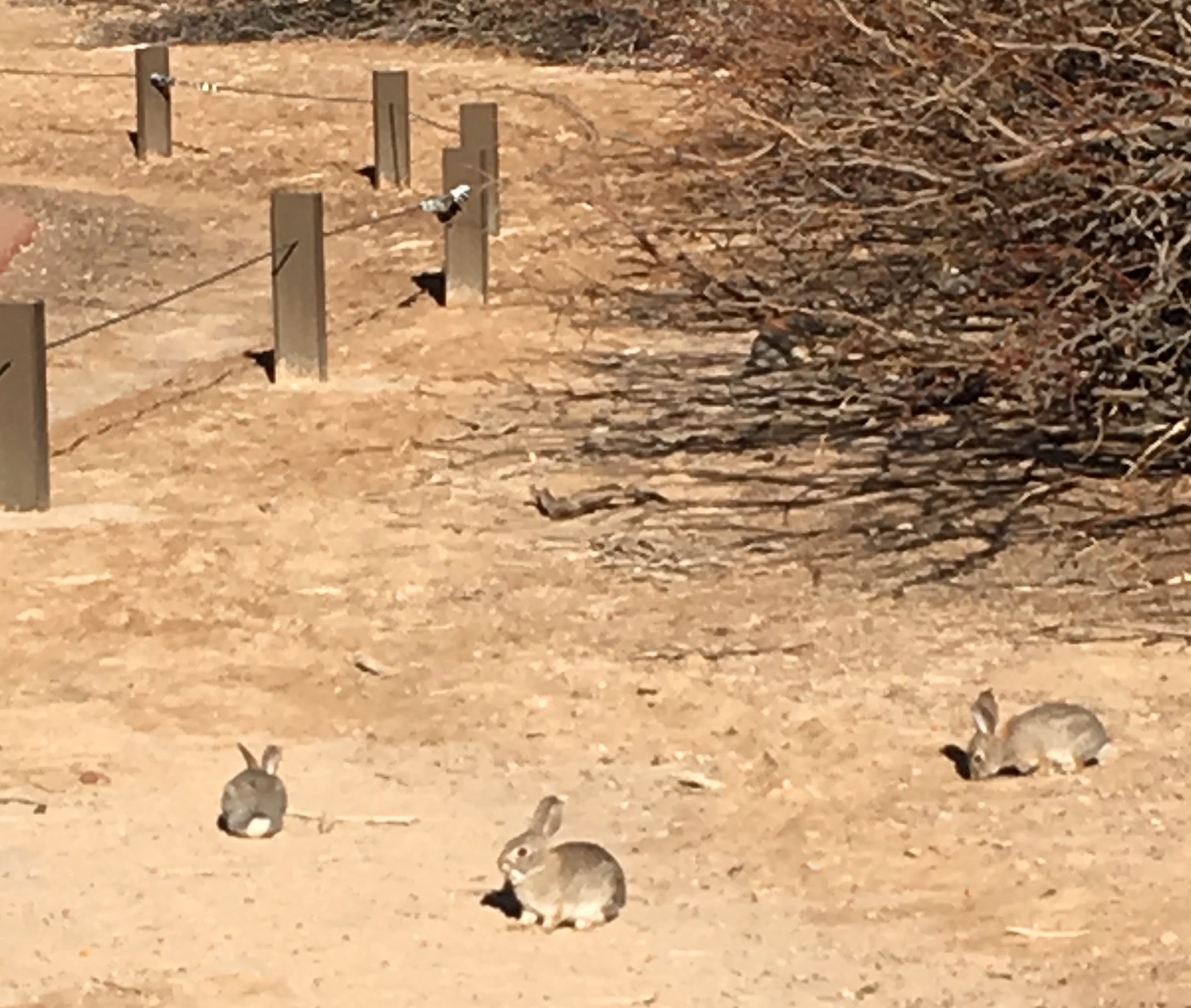
Bunna-Bunny Big Ears–desert hare or blacktailed jackrabbit?

Despite being right in the middle of Vegas, the race course seemed very nature-y and not particularly urban. I spotted at least two dozen bunnies, and during the 5k Laurel taught me that the ones I call Bunna-Bunny-Big-Ears are not bunnies, but hares. (Yes, I still make up names for cute animals I see while running. I blame the lack of oxygen to the brain.) Well, they might be blacktailed jackrabbits. But she also told me she learned that they can control their body temperatures with their ears. Very cool. I wish I could do that.


I was a little disappointed to not see any lizards while I was running, but it occurred to me that while lizards can be desert-dwellers perhaps they don’t like dunes?

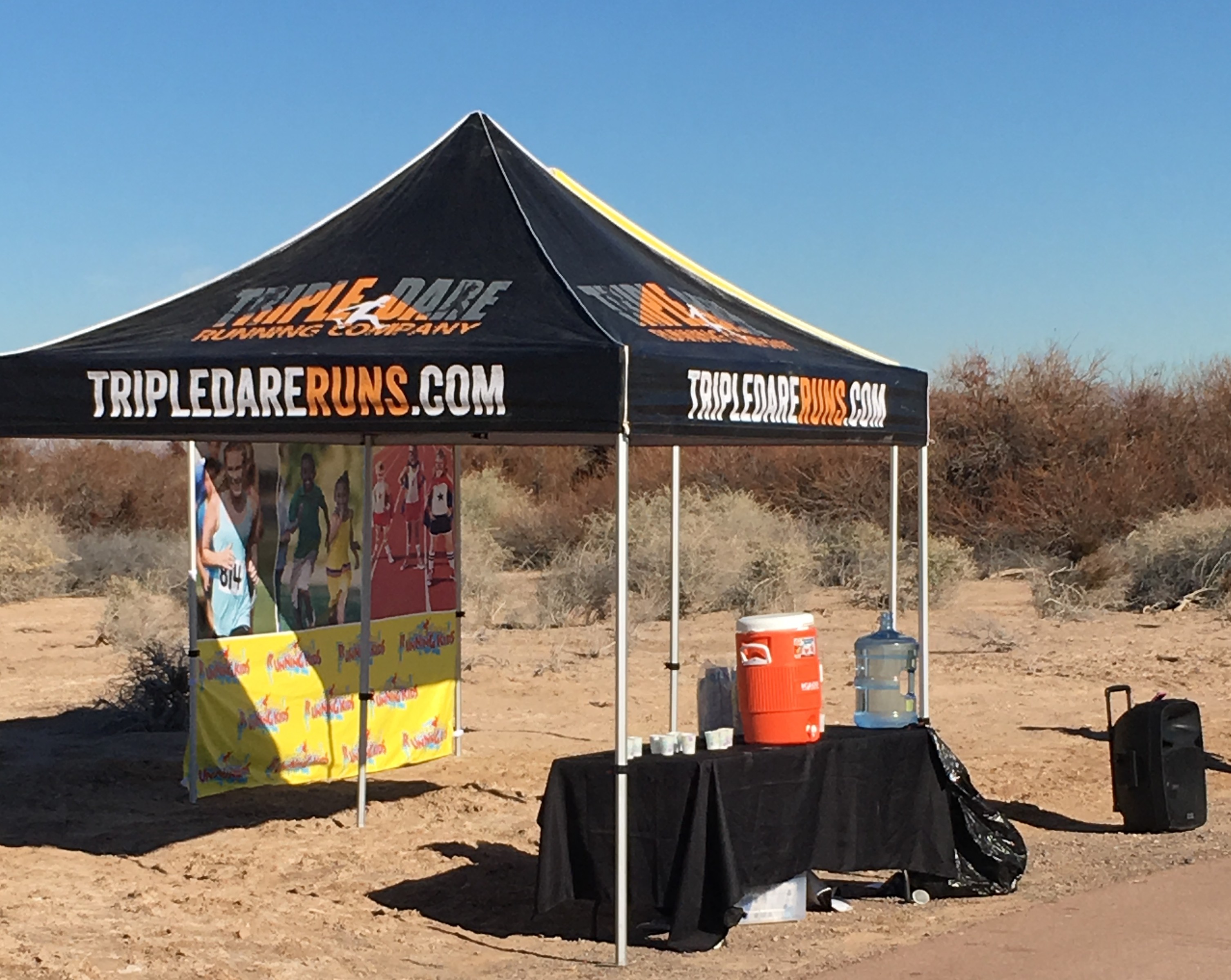
Sin City Run Aid Station--yes, thats just water
Sin City Run Aid Station–yes, that’s just water

The course had one aid station with water (and music and cheering) which each runner passed twice during the 5k run and four times during the 10k run. The course was marked on the blacktop with chalk, with cones and XXX where appropriate to make sure runners didn’t stray from the path. There were volunteers at every point where the course might have been even a little bit confusing, as well as at the few places where the course crossed a road open to vehicles. The volunteers were really great, cheering for every runner who went through the course. In the beginning this might have been so they could stay warm, but they kept up their enthusiasm even after the sun came out.

Bunnies!
Bunnies!

For the 10k, I decided to switch back to my usual 1-1 intervals (which later degraded to 30 seconds and 1:30 intervals) since my legs were just not feeling it. The sun came out, and the sky was blue, so it was gorgeous out, pretty much the perfect day for a run.  I tried to photograph my new “friends” during the 10k but they wouldn’t hold still. Every time I heard a new bird I stopped to see if I could find him, since I’ve never lived in the desert. I’m not sure how to describe the landscaping, but it was a natural mix of yucca-like stuff, a few cactus, and the usual desert-like trees. I could see mountains (and snow!) in the background.

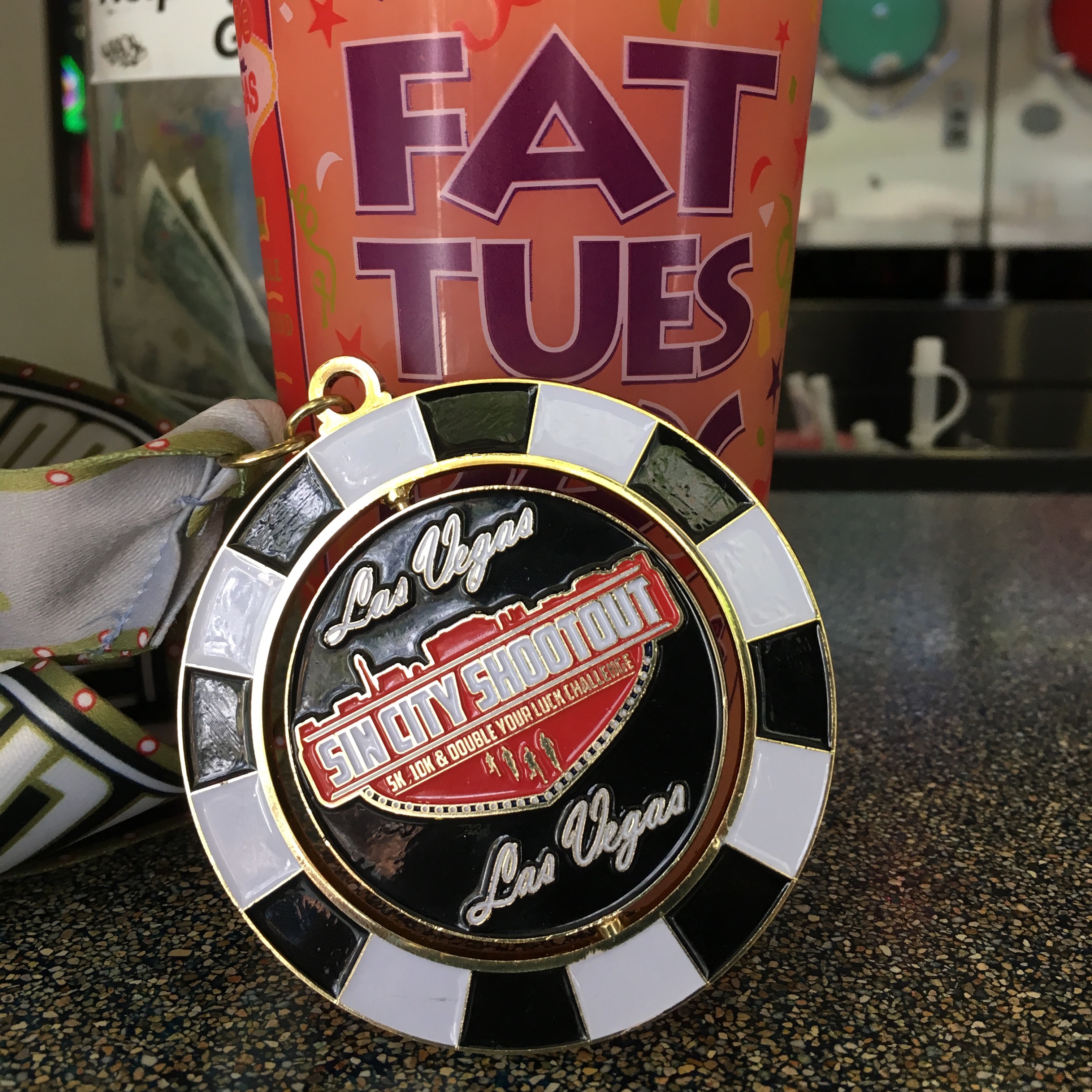
The finish line had someone to announce each finisher, which I thought was a nice touch for a smaller race. There is a single finisher medal for either 5k or 10k, though if you do both you get a bonus medal. The race medal is poker-chip-themed, and double-sided enamel. The bonus medal is also poker-chip-themed, and is a spinner. Both feature wide colorful ribbons. Overall, I thought these were executed beautifully.

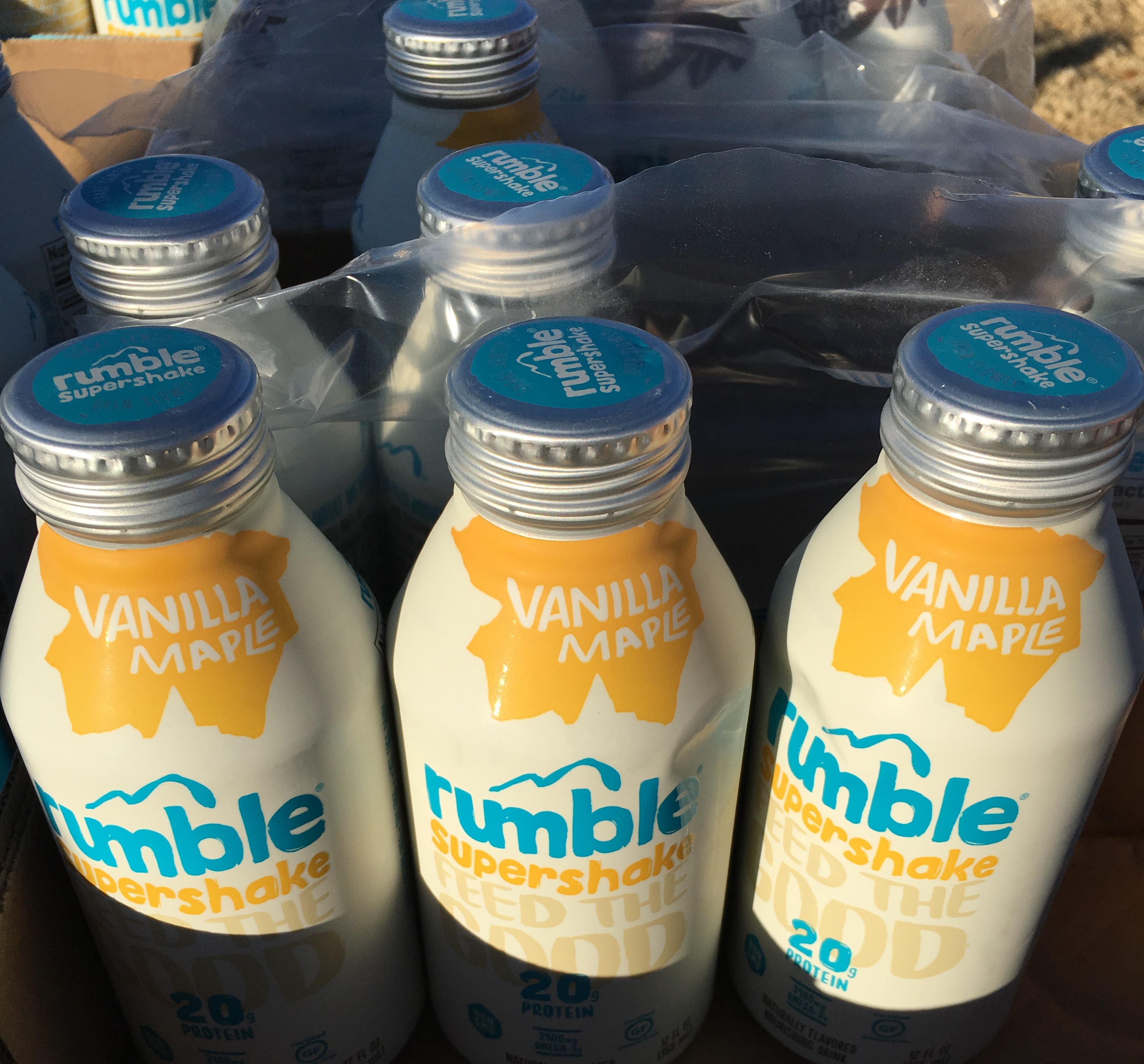
Why yes, that was a rumbly from my tumbly...
Why yes, that was a rumbly from my tumbly…

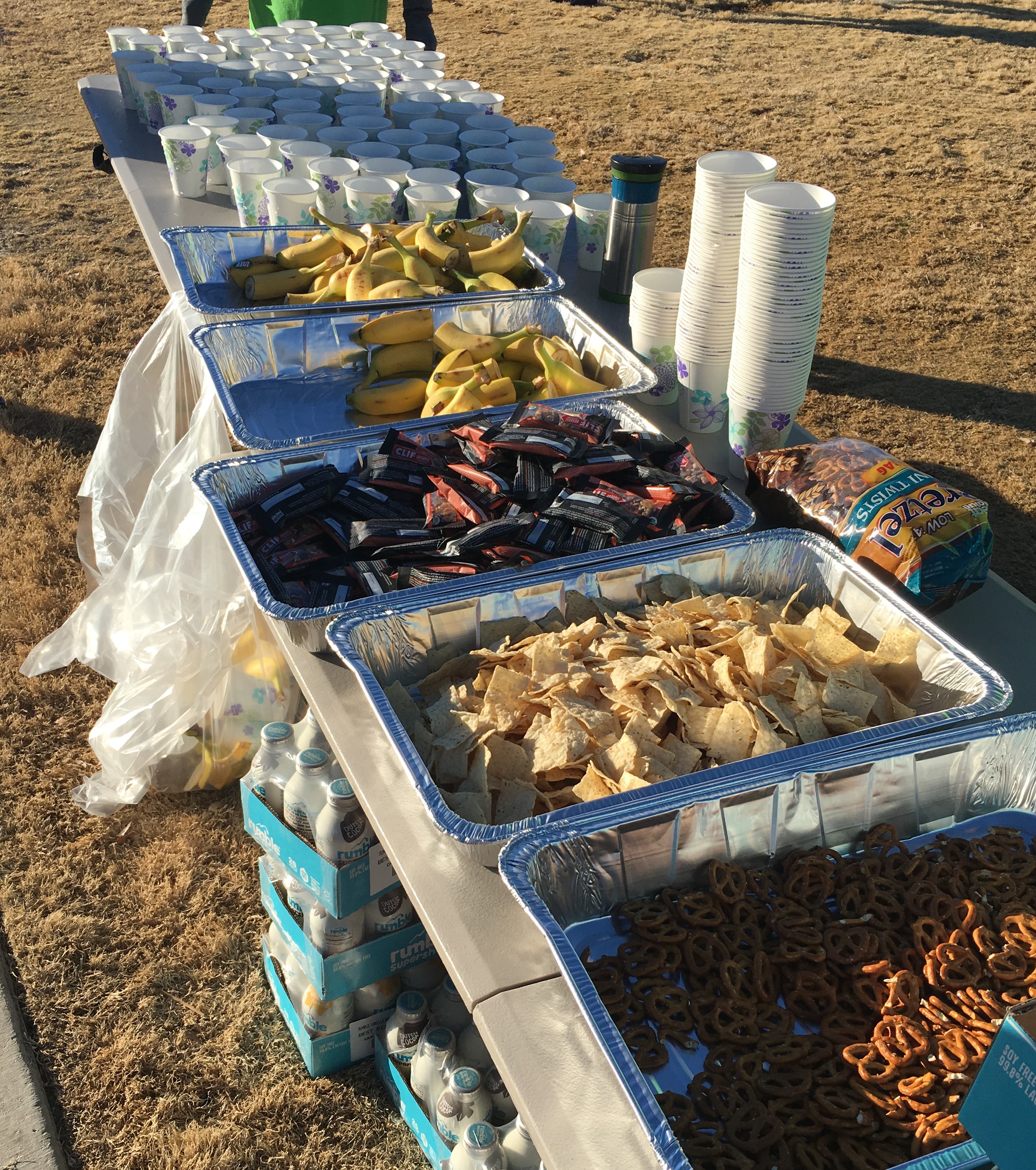
A few steps beyond the finish line runners had an assortment of post-race snacks, including a beverage called rumble that I’d never tried before. (The vanilla maple is delicious.) Other offerings were water, bananas, Clif organic trail mix bars, pretzels, and tortilla strips.

Post-race snacks? Yes, please! #EatAllTheFoods

As I wrote on BibRave.com, this is less of a “destination race” and more of a “race in a destination.” It was small but mighty! This is the complete opposite of the Rock ‘n’ Roll Las Vegas runs (which are huge, urban, and at night). This would be the perfect race for someone who wants to go to a small but extremely well-managed event. This would make an ideal race for a friends’ getaway weekend; I could see combining running these events with a longer weekend in Vegas—maybe go to the opening parties Friday, see an afternoon show Saturday, run Sunday morning, and then head to a champagne brunch buffet.

After my race, I convinced Laurel to drive me back to Harrah’s. I grabbed a shower, changed clothes, and put almost everything back in the suitcase. I met my roommate down in the high-limit room, and we headed to lunch and caught up. (I had almost convinced her to run with me, but since she was in town for a poker tournament she quickly came to her senses and decided staying out late and getting up early were not a recipe for a winning poker tournament.) When we said goodbye, I stopped to get a fruity frozen drink (because hello, Vegas).

Doesn't everything in Vegas merit a fruity drink?
Doesn’t everything in Vegas merit a fruity drink?

Disclosure: I received complimentary bottles of MinoTOR to review because I am a BibRave Pro. Learn more about becoming a BibRave Pro here. Read and write race reviews at BibRave.com! It’s a great way to choose between conflicting races, to help runners find the best races, and the help race directors improve each year. (Per usual, all opinions are my own–you should know by now I don’t need any help with that, I’ve got plenty of ’em!–and I don’t accept unlabeled advertorials.) 

In classical Greek mythology, the minotaur was a half-man, half-bull who lived in a maze. In the modern age, MinoTOR is a new performance beverage living in a maze of supplements (many of which are nutritionally worthless or can’t fulfill any of the claims they make–just check out the FDA’s latest smack-down actions or the New York attorney general’s latest suit to see what I mean). The name MinoTOR actually has nothing to do with the Greek bull-headed mythological monster, per the website:

The word “minoTOR” is a portmanteau.
A combination of two (or more) words or morphemes, and their definitions, into one new word. We took “mino” from Amino Acids and TOR from mTOR (more about that later) and put them together to form minoTOR™. Amino Acids are the building blocks of proteins. mTOR is the abbreviation of Mammalian Target of Rapamyacin. mTOR is a protein synthesis pathway that is vital for recovery and muscular growth.

I don’t like junky supplements, so MinoTOR had to win me over before I decided to test it out. Appealing aspects:

  • all claims backed by science explained on the website (by the way, I did my own reading for this blog post!)
  • no artificial colors, flavors, or unnecessary stuff
  • contains amino acids (key for recovery and muscle building)
  • low calorie, but not filled with sugar alcohols

As with anything I’m going to consume, I went to the website to read about it first.

The Other Ingredients.

Let’s start with the non-nutrional stuff inside. MinoTOR contains filtered water (of course!), cane sugar (real ingredient), citric acid (that’s like Vitamin C), natural flavors (legally defined term that’s not a big deal), acesulfame-potassium, and sucralose. Out of all of those, the only ingredients that are even mildly controversial are sucralose and ace-K, so I’m going to talk about those. Both are on the FDA’s list of accepted food additives, and are in use in the European Union as well. I haven’t found any credible study pointing to any serious health problem from consuming small amounts in moderation–if you find one, let me know.

Sucralose is a sweetener. When you eat it, your body doesn’t break it down very well, so most of it goes undigested, and thus contributes no calories to a product. It also has no effect on blood sugar levels, and does not contribute to tooth decay. Sucralose has been around since 1976 and is sold under the brand name Splenda. While one unpublished rat study claimed to link sucralose to leukemia, that study has been criticized for poor design; I wasn’t able to find other studies replicating that result that were published, peer-reviewed, or critiqued for design, and no studies showing any similar results in humans. Another recent study concluded that sucralose kills off good gut bacteria, but that study has been solidly questioned because it was funded by the sugar industry (which stands to profit handsomely from making anything other than sugar look as bad as possible); further, that study’s results haven’t been replicated in humans either.

Acesulfame-potassium is another no-calorie sweetener. It’s been around since 1967, and is sold under the brands Sunnett and Sweet One. It has a slightly bitter aftertaste, which means it can balance out the sweet flavor but also means it can’t be the sole sweetener used in a product (unless you want a bitter aftertaste). Both the FDA and the European Union (which tends to have stricter controls and regulation when it comes to food) approved it for general use. Again, the only studies I could find were rat studies, used a larger dose of ace-K than you will ever consume (like 3%+ of the rats’ total diet, which, according to Wikipedia, “would be equivalent to a human consuming 1,343 12 oz cans of artificially sweetened soft drinks every day”) and they are at best inconclusive. The studies were observing whether ace-K promotes tumor development; if you’re a male p53 haploinsufficient rat, the answer is “maybe.” At the same dose over 40 weeks, there was a limited effect on neurometabolic function. There was also some hypothesis that rat fetuses ingest ace-K via amniotic fluid or later from breast milk, and that it may influence their preference for sweet flavors. Something to consider if you decide to start drinking 1,343 12 oz. cans of diet soda each day.

Bottom Line: MinoTOR contains a small amount of sucralose and ace-K in order to keep the taste mouth-friendly without inflating the calories. You’d have to consume a ridiculous amount of diet soda (which is higher in both than MinoTOR) to come close to the dose any rat in any study received. (Also, you are not a rat.) I have zero worries about the sucralose and acesulfame-potassium in MinoTOR, and I’m fine with a small amount of artificial sweeteners as the last two ingredients in my beverage. A serving of MinTOR is half a bottle, and 50 calories. That’s a little over 8 ounces. To compare to the calories in other drinks, it is easiest to compare 12 ounces (the standard serving size for beverages). So let’s call it 75-80 calories. A few others for comparison are orange juice at 157-168 calories, and lowfat unflavored milk at 154 calories. A 20 ounce serving of cool blue Gatorade (a bottle) is 130 calories, which is similar to MinoTOR (8ish ounces = 50 calories, x 2 to get to 20 ounces brings it to 100 calories in 16 ounces).

A little aside…the sweetness factor/taste was the big dividing line between the Pros that like the taste and those that did not. 

Angie, another BibRave Pro, didn’t care for the sweet taste. She had a conversation with the MinoTOR crew about it too. You can read her experience on her blog, Marathang. She also took decent pictures (Mine were bad. Hence you don’t see them here.) Katherine agreed with Angie about the sweetness; her review is at Magic of Running.  Heather didn’t find the taste offensively sweet, and described it as more like coconut water. You can read her review at Heather Runs 13.1  Similarly, Erica over at Another Half Please found the taste just fine.

The Non-Ingredients.

Worth mentioning, MinTOR does not have artificial colors or flavors. Unlike some very popular drinks marketed as “sports drinks,” it doesn’t come in orange, red, or bright blue. It doesn’t have sugar alcohols, which upset some people’s GI tracts (and interesting fact at least one sugar alcohol, sorbitol, is regularly prescribed as a laxative).

The Main Ingredients.

For purposes of this discussion, I’m going to divide the ingredients into three categories: vitamins and minerals, caffeine, and amino acids.

Vitamins and Minerals. Straight from the label, you’ve probably heard of all of these:

  • Niacin (Vitamin B3)
  • Vitamin B6
  • Folic Acid (Vitamin B9)
  • Vitamin B12
  • Zinc
  • Chromium

With the exception of zinc and chromium, the ingredients in this category come in at 50% of the RDA. (Zinc is a little higher (83%) and chromium is lower (10%).) This is EXCELLENT news, as mega-doses of any vitamin are almost never a good idea and should be closely supervised by a doctor. For example, Niacin is a vitamin you need for overall good health, and there is some evidence that it helps to prevent atherosclerosis; it is used in extremely high doses to treat cholesterol imbalances, but needs close medical supervision because mega-doses can cause liver problems.

As a vegetarian I’m pleased to see B12 included. B12 is primarily consumed by humans in animal meat, but not because meat has B12–B12 is actually made by bacteria! (Animals, like humans, cannot synthesize B12 or make it within the body. They have to eat it.)

Caffeine. Look at any pre-workout supplement on the market, and you’ll see they ALL have stimulants. (“Green tea extract” is partially code for caffeine. Even yerba matte, consumed by Mormons because coffee and tea are forbidden by their religion, is naturally caffeinated.)  Most of them have hundreds of milligrams of caffeine. Pharma Freak’s “Super Freak” brand, for example, has 500 mg of caffeine. For comparison, 100mg of caffeine is about what you’d find in an strong cup of coffee, or one and a half cans of Red Bull. The various flavors of Coca Cola have between 34mg and 45 mg per 12 ounce can.

MinoTOR has 40mg of caffeine. Caffeine is the most widely-used stimulant in the world, and is safe for the general population in ordinary doses. (I’m not a doctor, but a can of Coke isn’t going to kill the average person.) A quick Google search of “caffeine for runners” returned 457,000 results; the top of the page includes articles in Runners World, Competitor, The Guardian, and Active.com so if you want to read more about why caffeine before a workout, Google yourself silly. Or pick up the book, Caffeine for Sports Performance, by sports dietitians Louise Burke and Ben Desbrow and exercise physiologist Lawrence Spriet.

Amino Acids. As you’ve likely forgotten from high school biology, amino acids are the building blocks of proteins. When you eat protein (which is a bunch of amino acids stuck together), your body breaks it down into the component amino acids, and then shuttles those amino acids off to where they are needed in the body. For athletes, amino acids are critical for muscle repair (which leads to muscle growth) as muscles are at least one-third amino acids. That’s why branched chain amino acids (BCAAs) are popular supplements. I highly recommend the BCAA article on Precision Nutrition to learn more.

Amino acids come in two basic types. Essential amino acids are those the human body must obtain through food or drink–you have to eat them. Non-essential amino acids are those that the human body can manufacture within itself. The amino acids in MinoTOR are:

  • Leucine (this is a BCAA)
  • Beta-alanine
  • Isoleucine (this is a BCAA)
  • Valine (this is a BCAA)
  • Taurine
  • Sustamine™ (L-Alanine and L-Glutamine)

If you’ve ever gotten into an argument with someone who tried to make their dog or cat a vegan, you probably know that for dogs and cats, taurine is an essential amino acid–that’s generally the reason why they are obligate carnivores. (Please, don’t try to make your dog or cat vegan.) In humans, taurine is a non-essential amino acid. I confirmed with the company founder, prior to trying MinTOR, that the taurine is from vegetarian sources. So it is vegetarian-friendly.

Amino acids also serve other critical roles in the human body that are of particular interest to athletes. They assist in nitrogen transport, and production and transportation of glucose (aka the carbs your body uses for fuel), for example.

The Experience.

Okay, science is super awesome, but what about the drink? Sure, I’m getting to that.

Taste. MinoTOR has a slightly sweet taste that reminds me a little bit of coconut candy. It isn’t super sugary. It feels like water in your mouth, or maybe water with a little bit of sugar.

Performance. The bottle makes six claims, “Formulated with ingredients designed to:

  1. Increase energy
  2. Buffer lactic acid
  3. Accelerate recovery
  4. Improve oxygen utilization
  5. Promote muscular growth
  6. Boost metabolism”

These are all things that I can only evaluate subjectively. There’s zero science or study design here, because I can’t do a double-blind test with water (MinoTOR has a flavor, and I’d have a hard time fooling myself). I don’t have massive lab equipment to test how my muscles handle lactic acid, or whether my body is more efficiently using oxygen. Finally, since I’m reviewing this product and I know what it is supposed to do, I can’t avoid observational bias.

My Testing… All that aside, I tried MiniTOR before starting two of the 21 Day Fix Extreme workouts with Autumn Calabrese. These are targeted workouts with weights, about 30 minutes each, broken into sets of 2 or 3 exercises; upper body uses drop-sets, while lower body goes from weighted movements to plyometric ones.  I didn’t even pretend to try to do everything the same way, too many variables to control.

Test #1: 21 Day Fix Extreme: Upper Body Fix. For this session, I worked out first thing in the morning on a weekend. After I got up and threw on workout clothes, I drank half a bottle of MinoTOR and then waiting about 30 minutes before I did the workout. While I couldn’t bang out all of the push-ups, even with the modification (which isn’t “girl style on your knees” but “don’t drop as much and stay in full-body plank”) that was because my hands are apparently just not built for push-ups. I managed to do almost everything else in the workout minus the triceps kick-backs (dumb exercise, difficult to hit the target muscles and very easy to have bad form in my messed up shoulder) which I swapped for skull-crushers. At the end of the workout, I felt great. I had a post-workout protein and carb snack before my shower, and went about the rest of my day. The NEXT morning, ow!!! HOLY DOMS BATMAN!!! (DOMS = delayed-onset muscle soreness.) Yes, I killed that workout, but that workout tried to kill me right back. After teaching the morning yoga class, I felt much better. Conclusion: if MinoTOR makes the workout seem easy-ish when clearly I’m kicking butt–wimpy workouts do not cause sore muscles–then I’m for it. I’ll definitely drink it the next time I try this workout.

Test #2: 21 Day Fix Extreme: Lower Body Fix. For this session, I worked out in the evening, after work. (Actually it was after work, driving home, and doing some computer work.) It had been some time since I had lunch, so between driving home and working out, I had a small serving of cheese tortellini and drank the other half of the bottle of MinoTOR. The lower body workout seemed much more difficult than the upper body workout, I suspect because the lower body muscles are bigger, and I know I have weak glutes and hamstrings. This workout was definitely much more challenging, and I had to drop out to catch my breath several times (no, this was not an aerobic workout, thanks). But I finished it, and kept good form for every rep I banged out. Next time, I should try to eat the pre-workout snack earlier, as my stomach definitely let me know it had stuff in it. Conclusion: I’m pretty sure I’m going to be sore tomorrow. Even though I detest getting up early, I think my morning MinoTOR plus workout was better than the evening one…though I suspect this was due to poor timing of the snack.

OverallI’m glad I had the opportunity to try MinoTOR. I’ll definitely use it for future weighted workouts.

Want to try MinoTOR? Head over to the MinoTOR website and enter code BIBRAVE1. You’ll get 10% off and FREE shipping. You can also follow MinoTOR on social media to ask questions, and learn more.

Twitter: @drinkminotor
Instagram: @drinkminotor
Facebook: https://www.facebook.com/drinkminotor

It was a dark and foggy morning...
It was a dark and foggy morning…

If you run and have internet access, you’ve probably heard of The Oatmeal and the book, “The Terrible and Wonderful Reasons Why I Run Long Distances.” (If you haven’t, hie thee to the website and go read it already!) After the book was released last year Mr. Inman (that’s The Oatmeal, and the author of The Oatmeal) announced a trail race in Washington state. The 2,000 available slots sold out so quickly he added a second day. While there was also a virtual option for the inaugural Beat The Blerch, there is nothing like being there–virtual racing is not virtual reality.

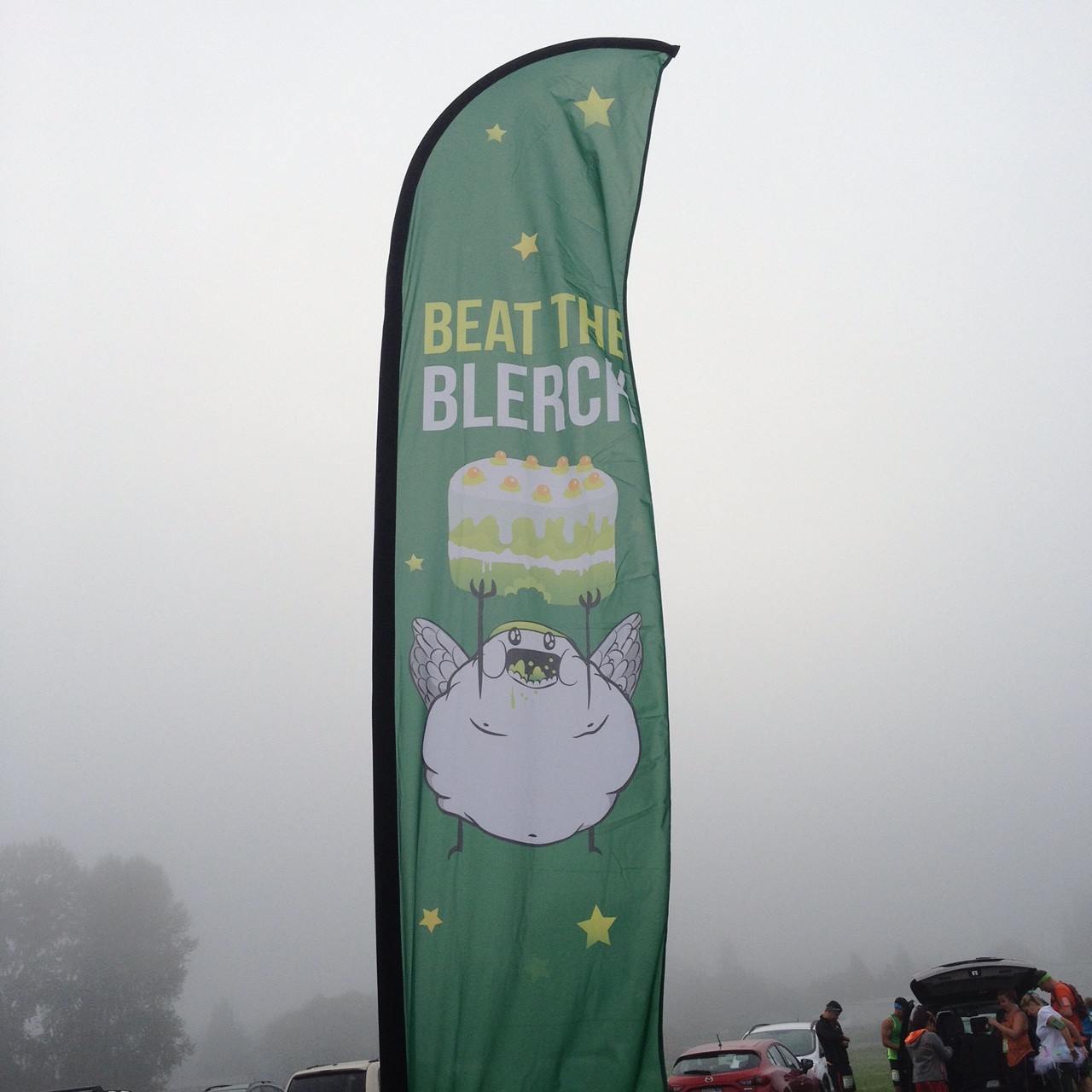
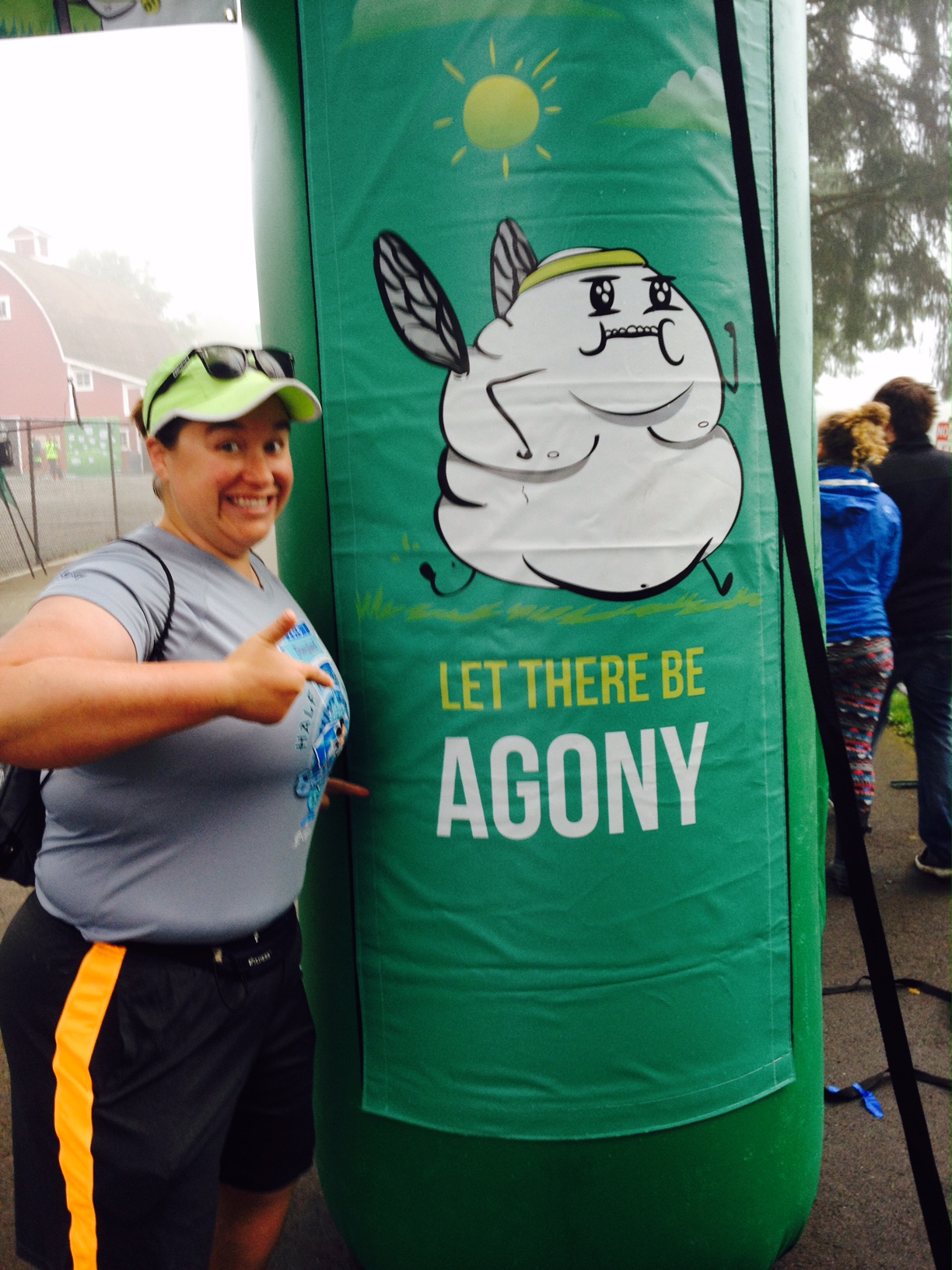
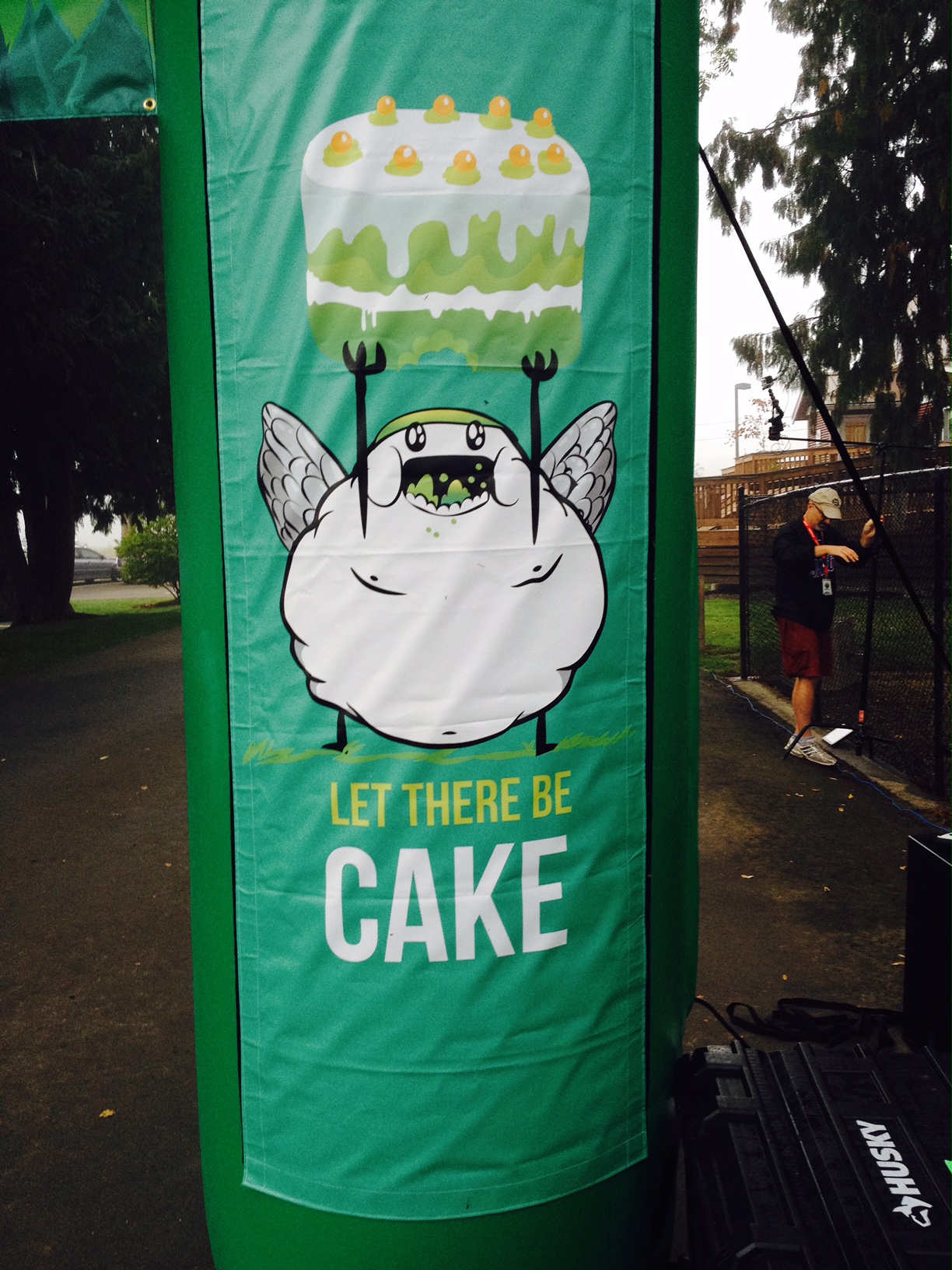
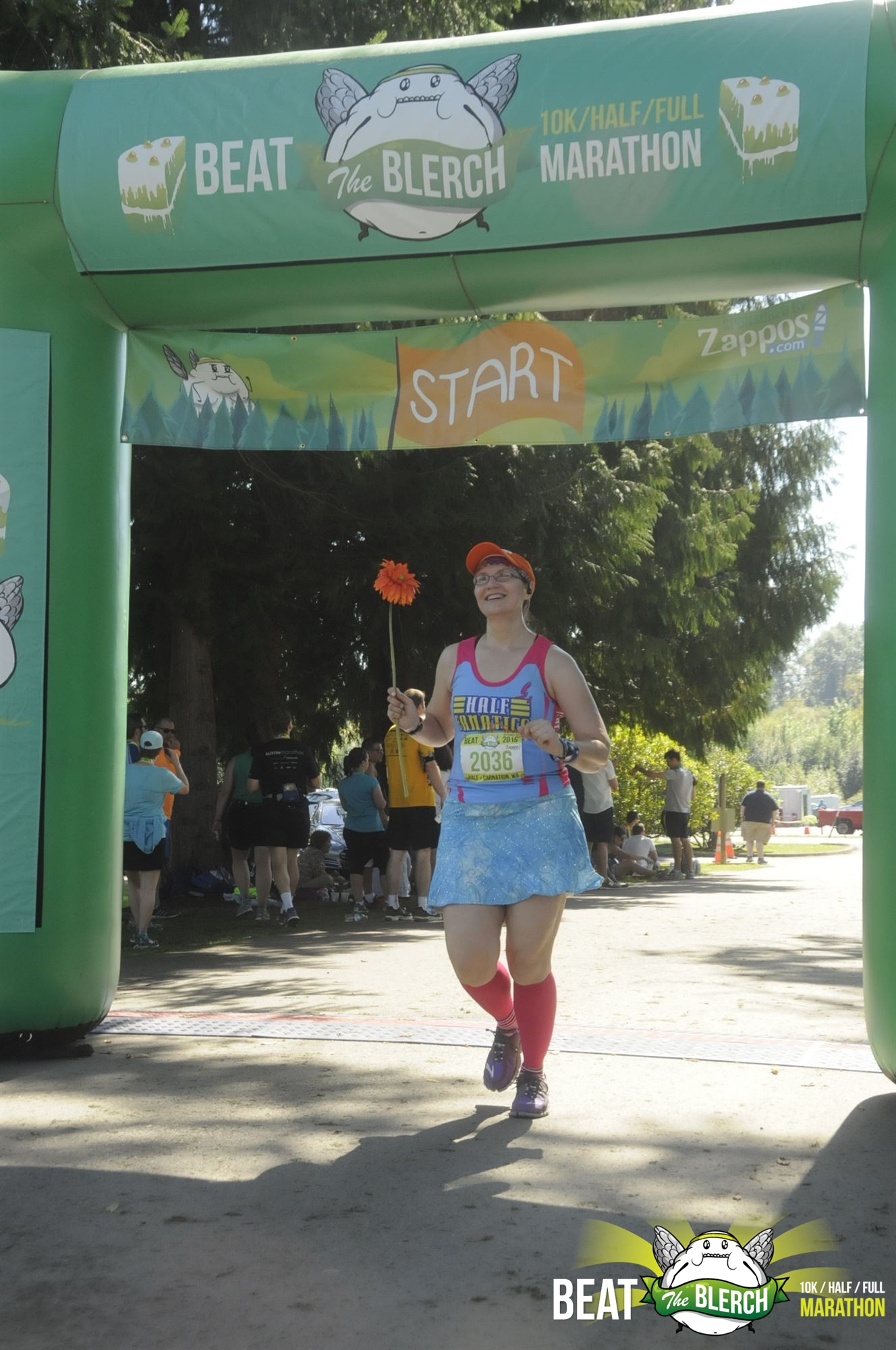
Appropriately decorated starting line!

For 2015, Beat the Blerch became a series: two days in Carnation, WA plus a race in Sacramento and another one somewhere in New Jersey. While Sacramento is closer to me in terms of travel, it happened to conflict with another event I’d already registered for, so it was off to Carnation for me! My friend Jennifer asked if I’d like to share costs on a hotel and car, and just go for one night. It might seem goofy to fly up on one day and fly back the next, but I’ve done so much travel for running and work this year that I am starting to cherish the nights I get to sleep in my own bed.

It’s just a quick hop from Oakland to Seattle (I #LUV Southwest Airlines!) and we packed in carry-ons only, so we were quickly at our destination. Jennifer introduced me to the game Ingress (another post for another day) as we grabbed a quick meal and then headed off to bed.


As promised, there was cake
As promised, there was actual cake on the course.


One of the things I love about run travel is hanging out with other runners. When sharing space to prep for a race, I often find I learn sweet new running tips, and this race was no different. Race day morning we laid out our stuff, grabbed some items from the hotel’s breakfast buffet, and headed over to Carnation. We we’re sure about parking and logistics, so we arrived super early. Like I think we were the fifth car parked in our lot. It was a quick maybe five minute walk over to the packet pickup area, where we got bibs, shirts, and other Blerch-based swag in our runner packets (packaged in a Zappos bag with an adorable Blerch right on the front).


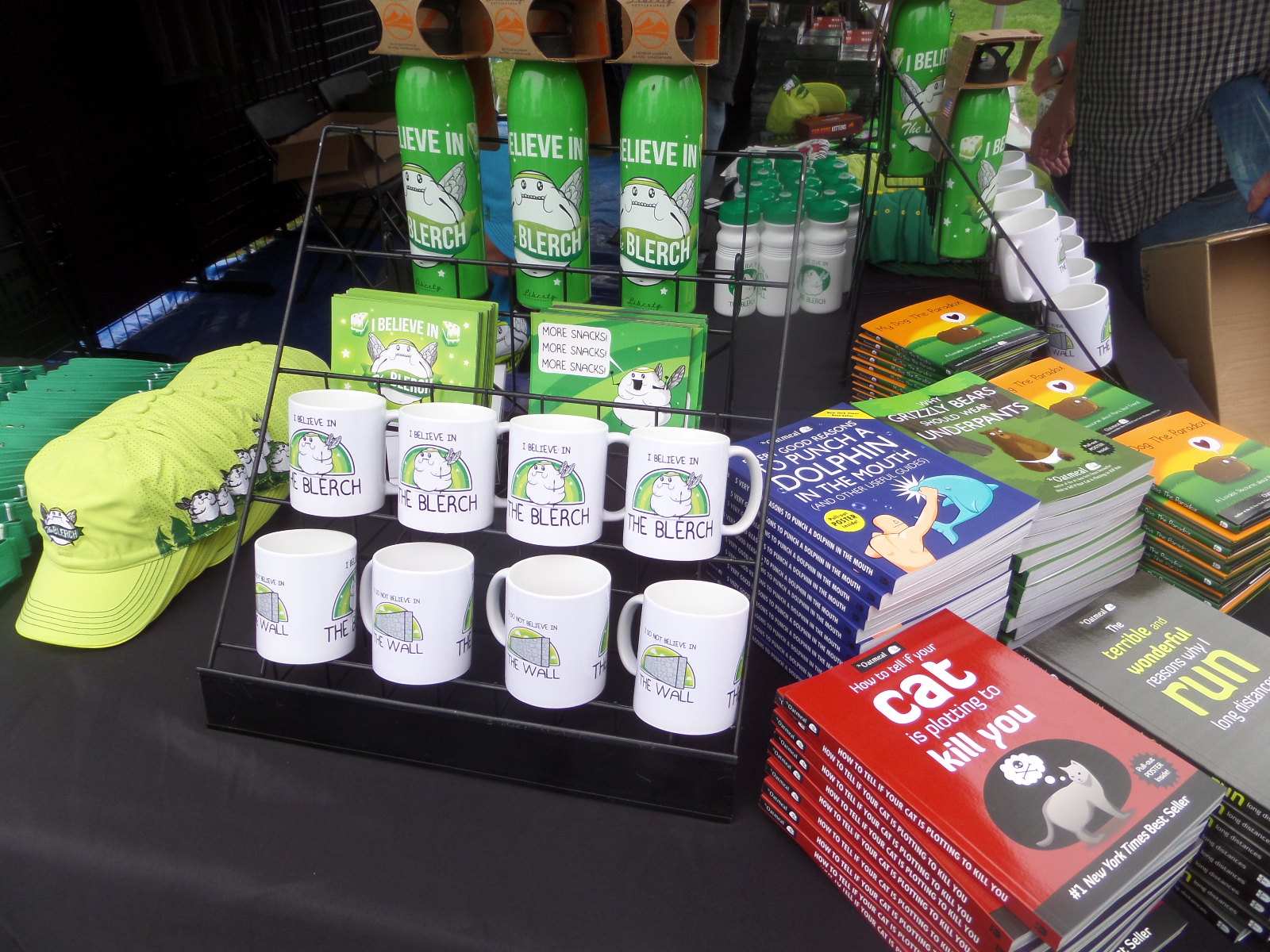
Mugs, water bottles, books! Christmas in September!


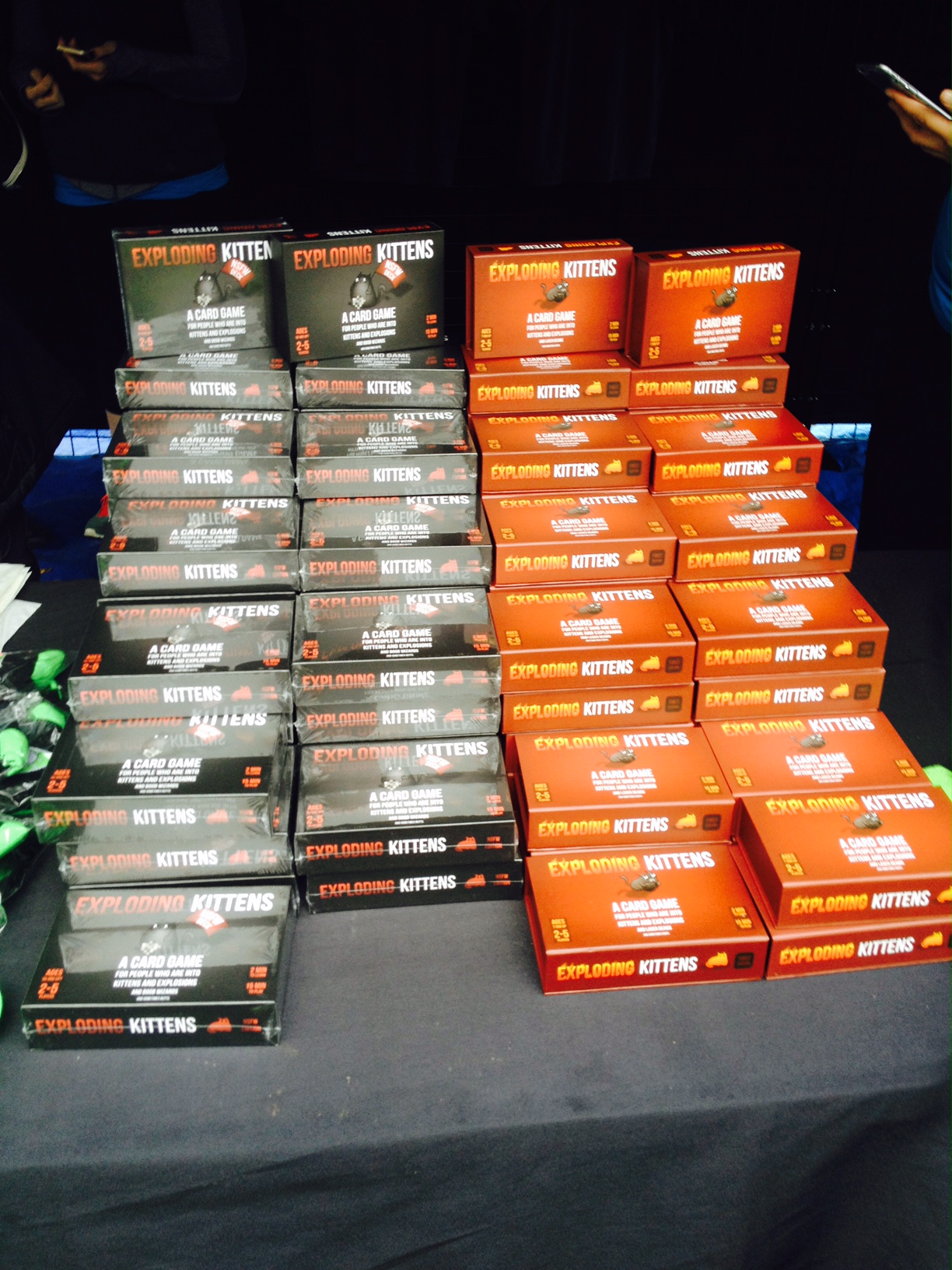
Exploding Kittens: Kickstarter Edition

Naturally we also had to check out the Blerchandise. In addition to water bottles, coffee mugs, Oatmeal graphic novels, stickers, shirts, and socks, runners could also get copies of the newly released Exploding Kittens card game. I already had mine–and the NSFW edition–since I participated in the KickStarter. These were the last of the KickStarter edition decks, so any runners who missed out had one last chance…


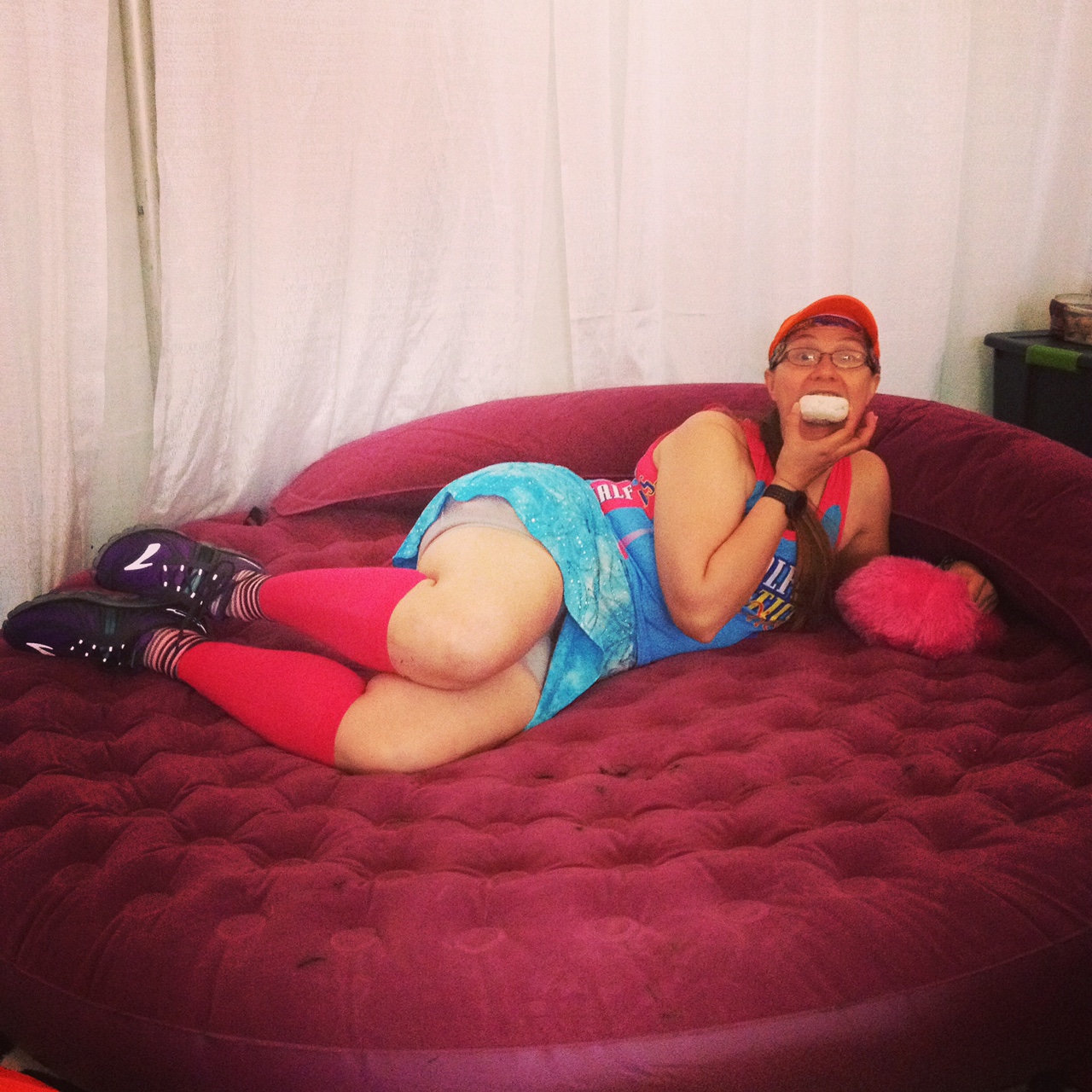
Who knew a pre-race donut could be so relaxing? (Probably my friend Angie, but that's another story)
Who knew a pre-race donut could be so relaxing? (Probably my friend Angie, but that’s another story)

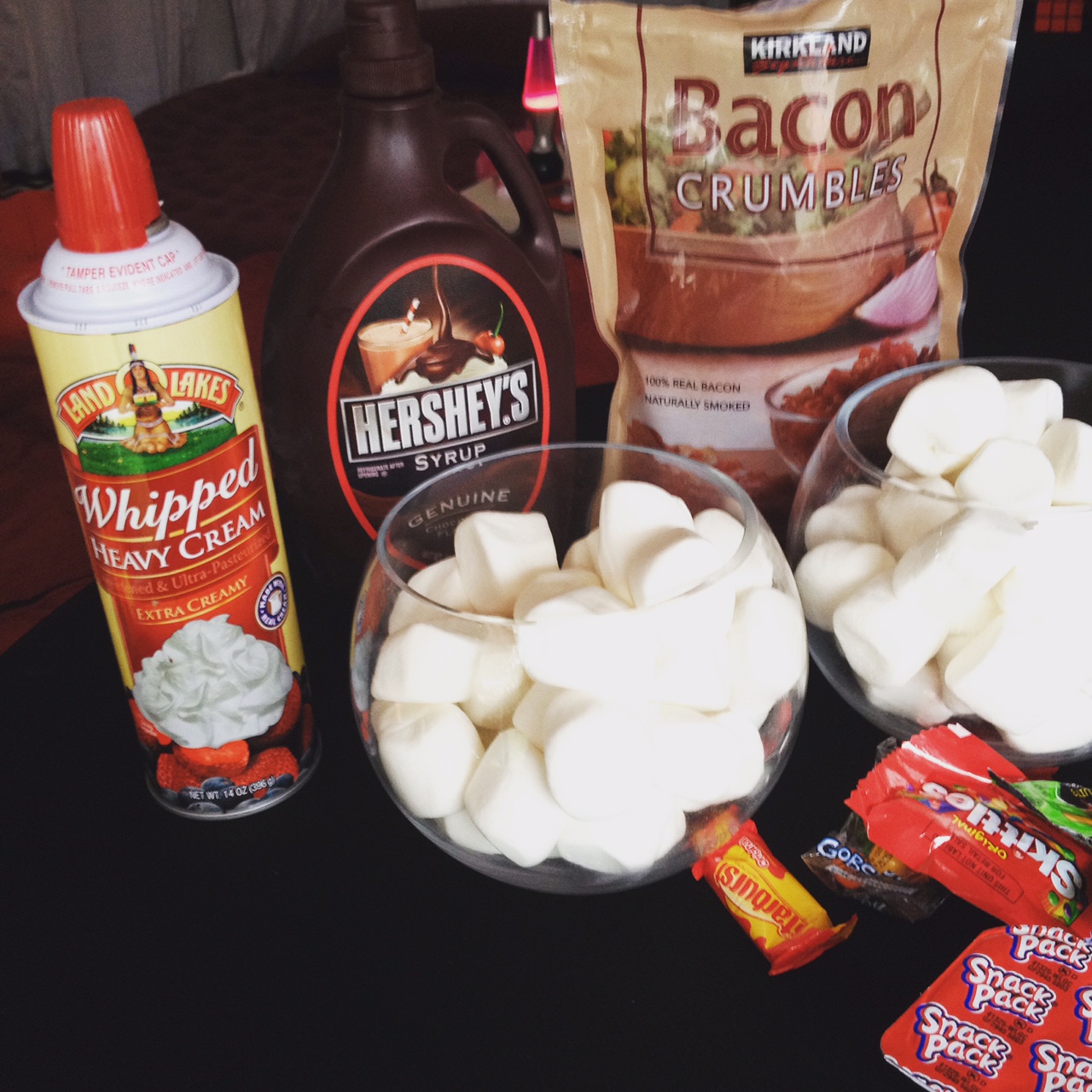
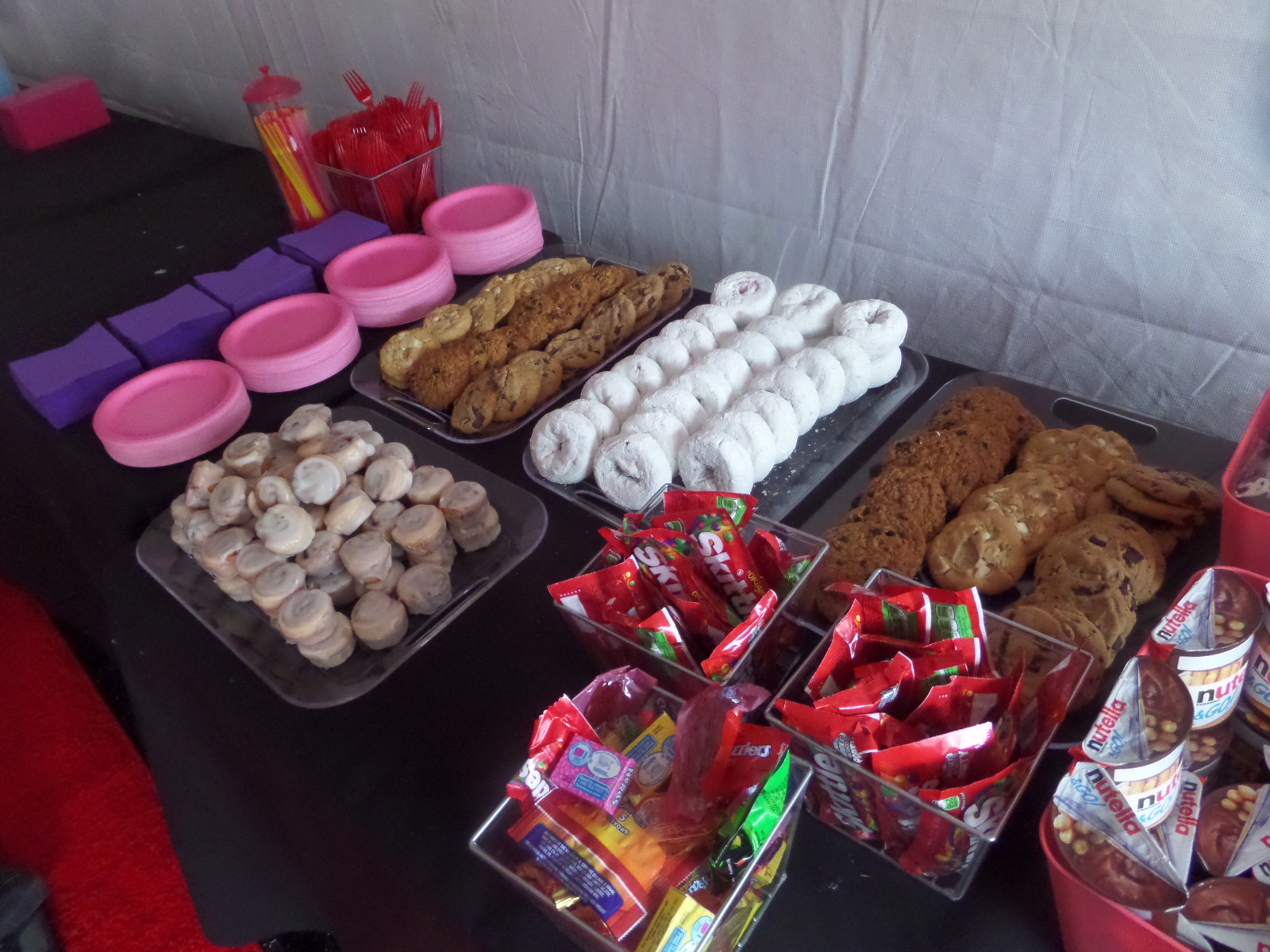
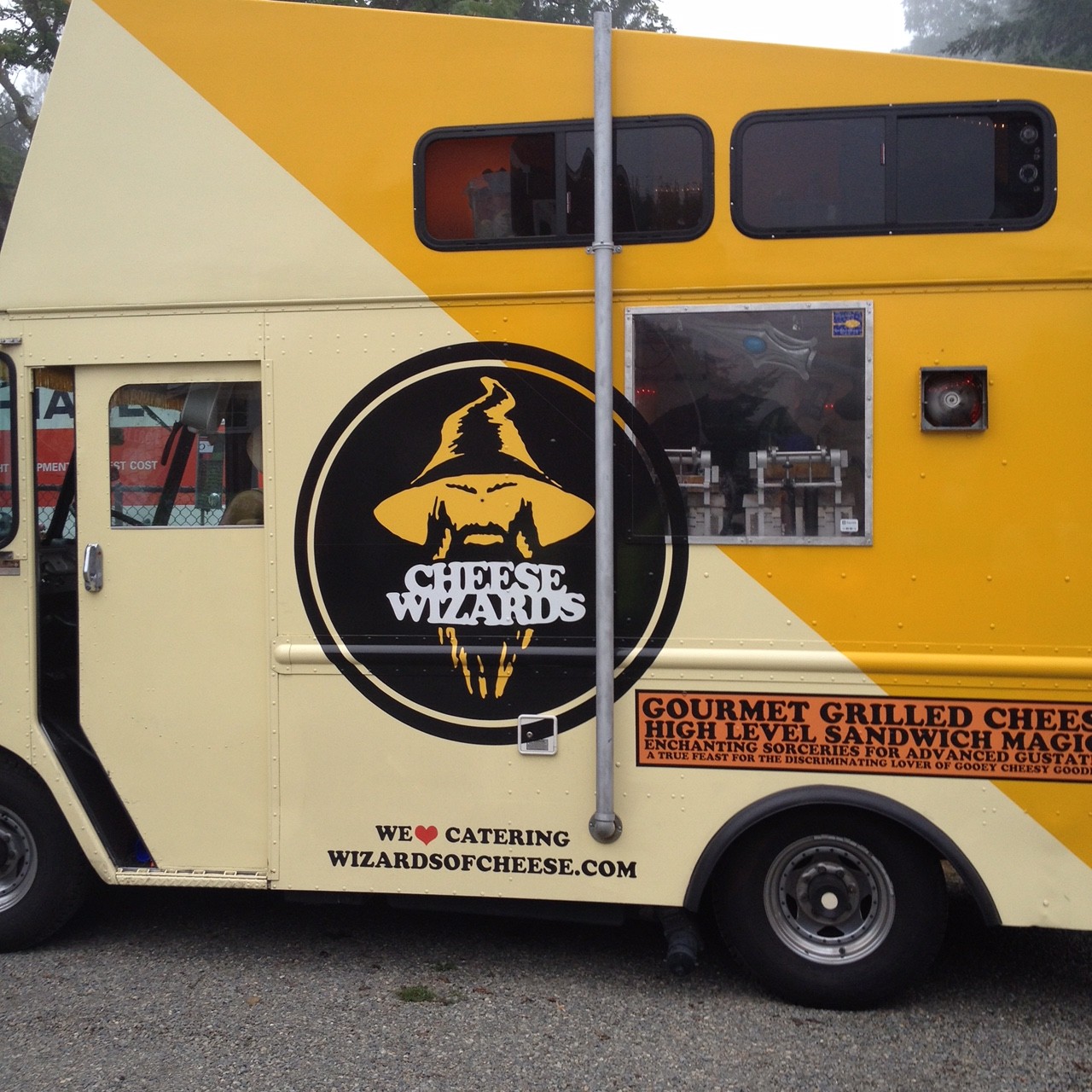
After dropping our stuff in the car and putting on the bibs, it was time to loll around in the Zappos lounge. I was glad we were early enough to enjoy the pre-race festivities! In addition to the soda and junk food buffet, there were warm grilled cheese sandwiches and a DIY marshmallow treat station. After indulging we lounged on some giant airbed sofas with furry cushions while watching junk TV.  I’m not going to lie, I was a little worried about eating half a grilled cheese right before the race. (To save you the suspense: I’m now wondering whether I can hire a grilled cheese truck to follow me to races.)


Marshmallow creation station--who knew whipped cream on a marshmallow could be so good?
Marshmallow creation station–who knew whipped cream on a marshmallow could be so good?

Actually I had no desire to eat most of the things inside the Zappos lounge. The lounge staff encouraged us all to languish on the fuzzy sofas and watch just a few more episodes of Real Housewives. (“You don’t really want to RUN, do you? It’s so cozy and relaxing here!”)


Buffet pants!
Buffet pants!

Over in the Zappos tent, I also learned something new: “buffet pants” (and bought a pair, of course). Buffet pants are for post-race loungewear….or lazing around the house, or perhaps on the way to a basketball game. (I’ve actually never worn mine outside the house…)


The buffet: part two, baked goods


Not the "boob wizards" of the NSFW edition of Exploding Kittens, but pretty good wizards
Not the “boob wizards” of the NSFW edition of Exploding Kittens, but pretty good wizards

Prior to the race I indulged in not just the grilled cheese, but also a donut, and a marshmallow covered in chocolate sauce, and a few other carbolicious snacky items. I decided not to eat the packaged candy, passed on the chips, and left all of the soda in the cooler. Past races have taught me that carbonated beverages before a race–no matter how tasty and appealing they may be–BAD IDEA. (Save the champagne for after the race. Or practice belching. ’nuff said.) Seriously though, the grilled cheese was a great idea. The truck just kept bringing them out, and I’d watch to see if there was a plain cheese (some had bacon in them, of course). I was trying to figure out how I could make my own grilled cheese on race day mornings, but frankly I hate mornings and usually  barely get up in time to press play on the coffee pot. So until I manage to find a grilled cheese truck to follow me around, this is likely my last race with tasty gooey cheesy goodness for breakfast.


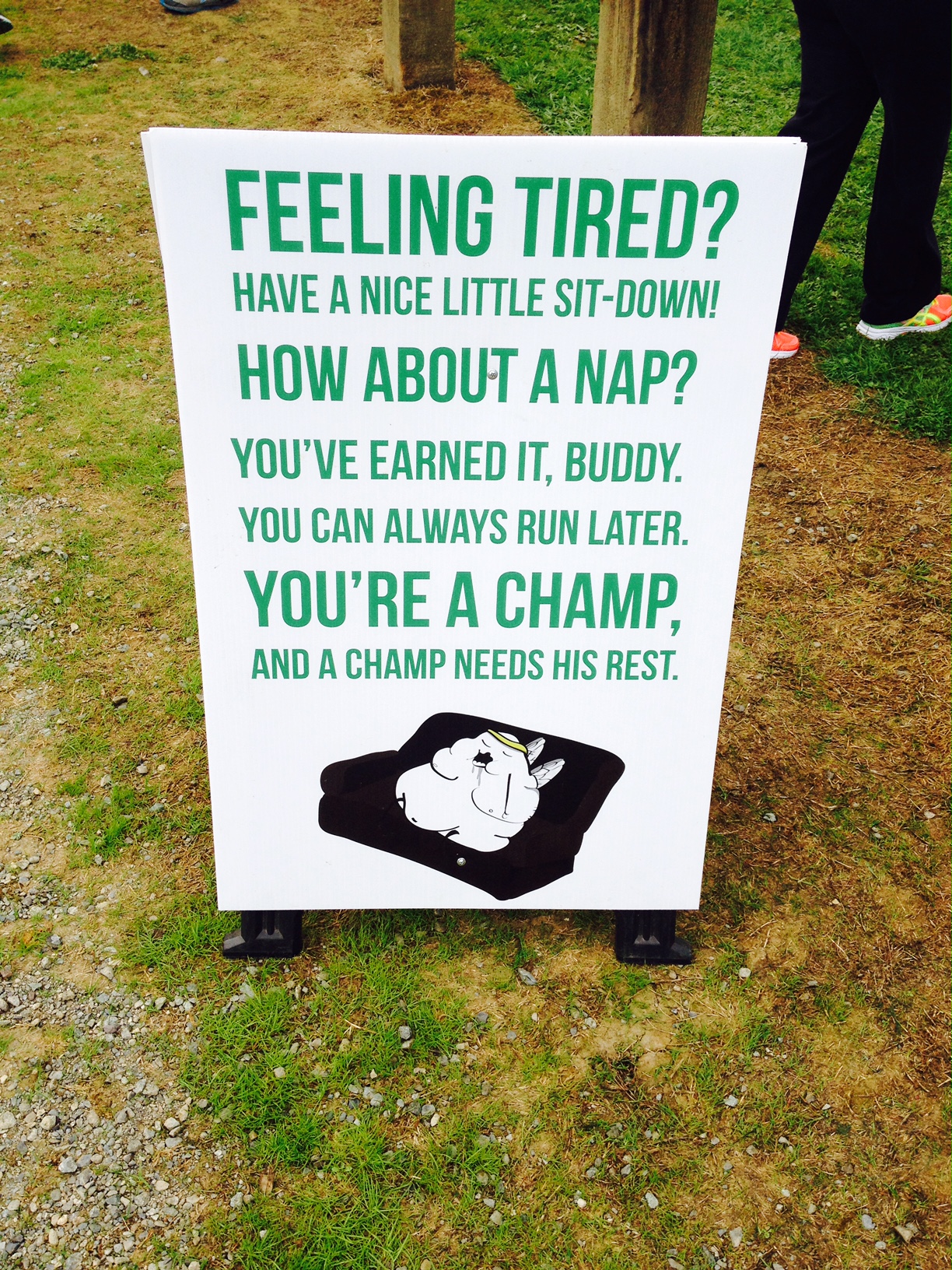
Blerchy advice
Blerchy advice

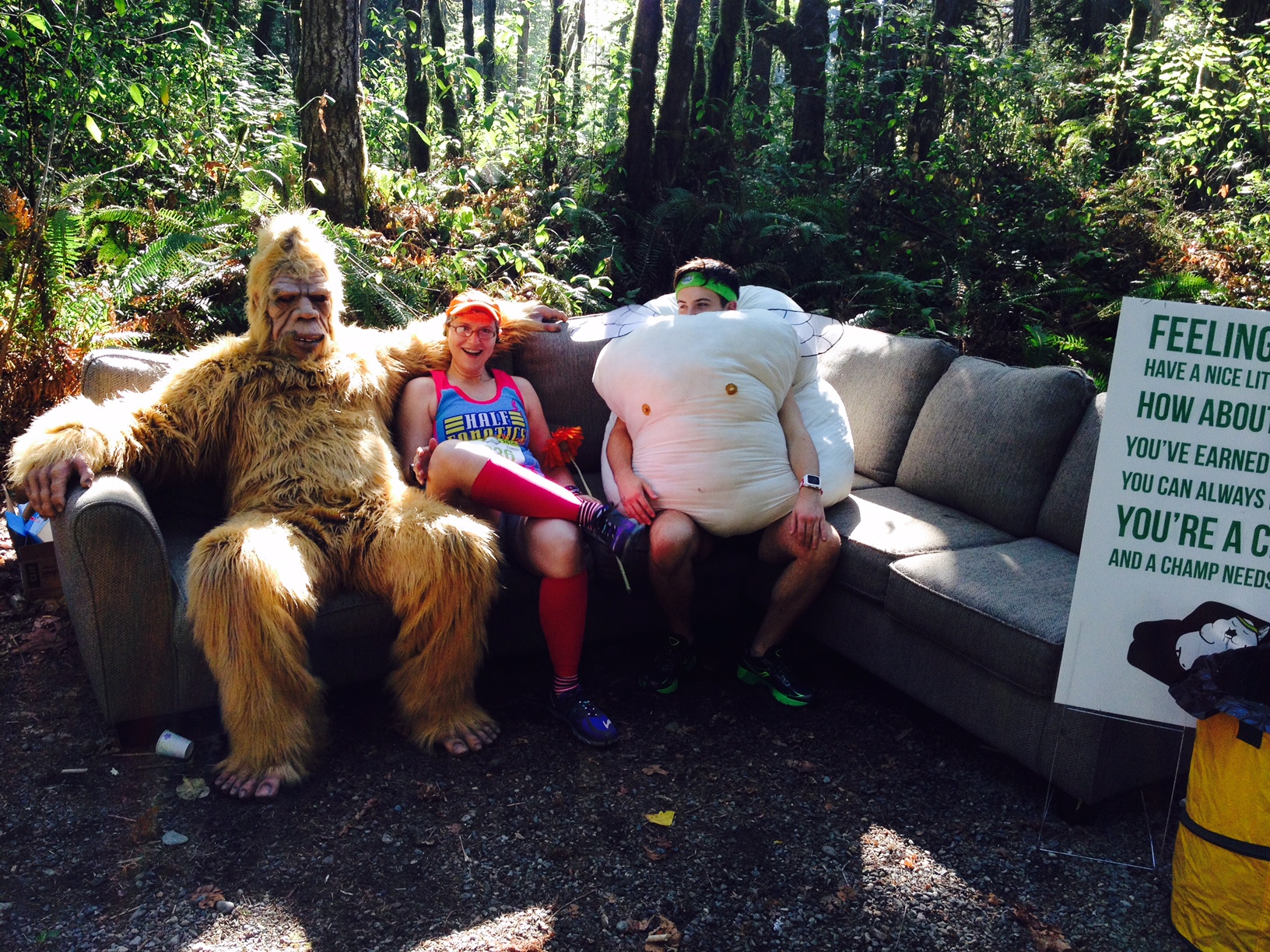
As promised, the aid stations featured cake. Nuun was a great stand-in for the magical purple fizzy beverage. (Seriously, just go read “The Terrible and Wonderful Reasons Why I Run Long Distances.” You might just want to buy the book, too–then you can bring it to the 2016 Beat The Blerch race to have it signed.) There were also multiple photo opps with Blerches, Sasquatch, and sofas. Shenanigans ensued. Some actual running happened as well, but I was busy taking pictures and enjoying myself, definitely not gunning for a PR or an age group award. For the most part, people seemed to be having a good time. The only drawback is that when you put cake in a Dixie cup, it sticks to the sides, and you have to either pull apart the cup or use a finger (questionable when running) to pry it out. The forks were at the finish line.


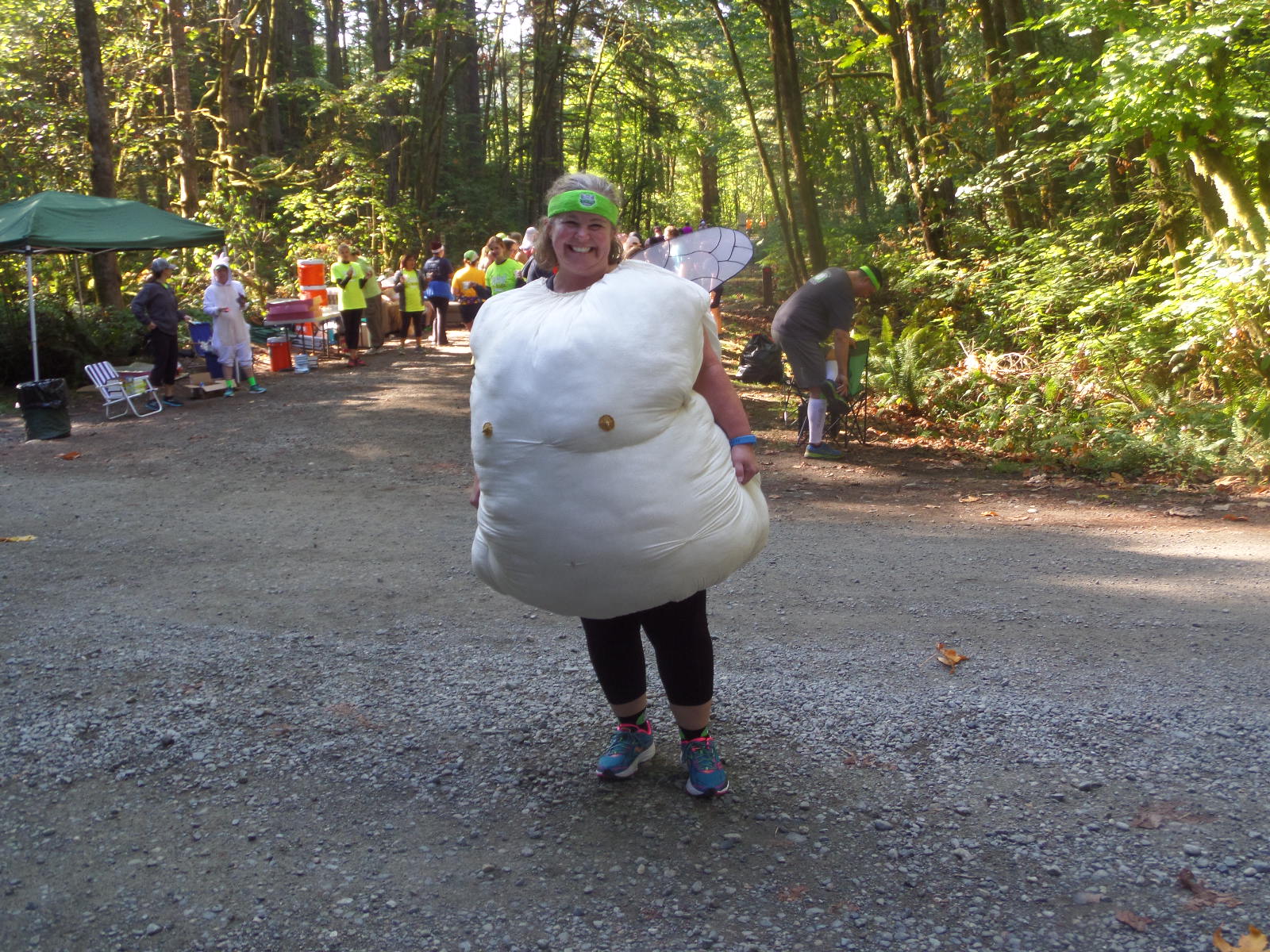
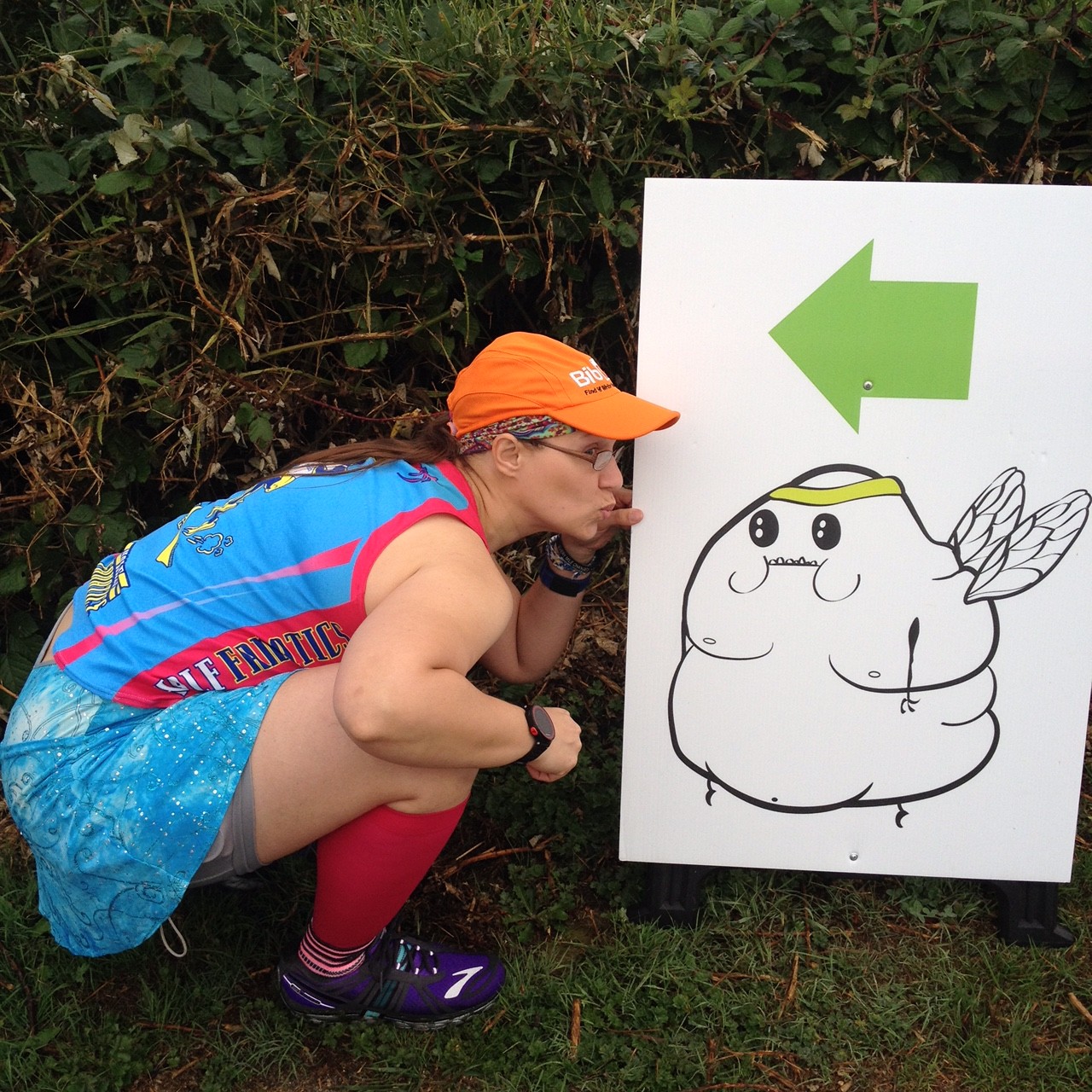
On-course Blerch!
On-course Blerch!

I posted a few pictures online for my friends, and the ones who are not runners were notably confused. (“I’m not judging,” wrote one, “and I’m willing to be educated, but…why does that giant marshmallow have nipples?”)


Every race should have sofas at the aid stations.
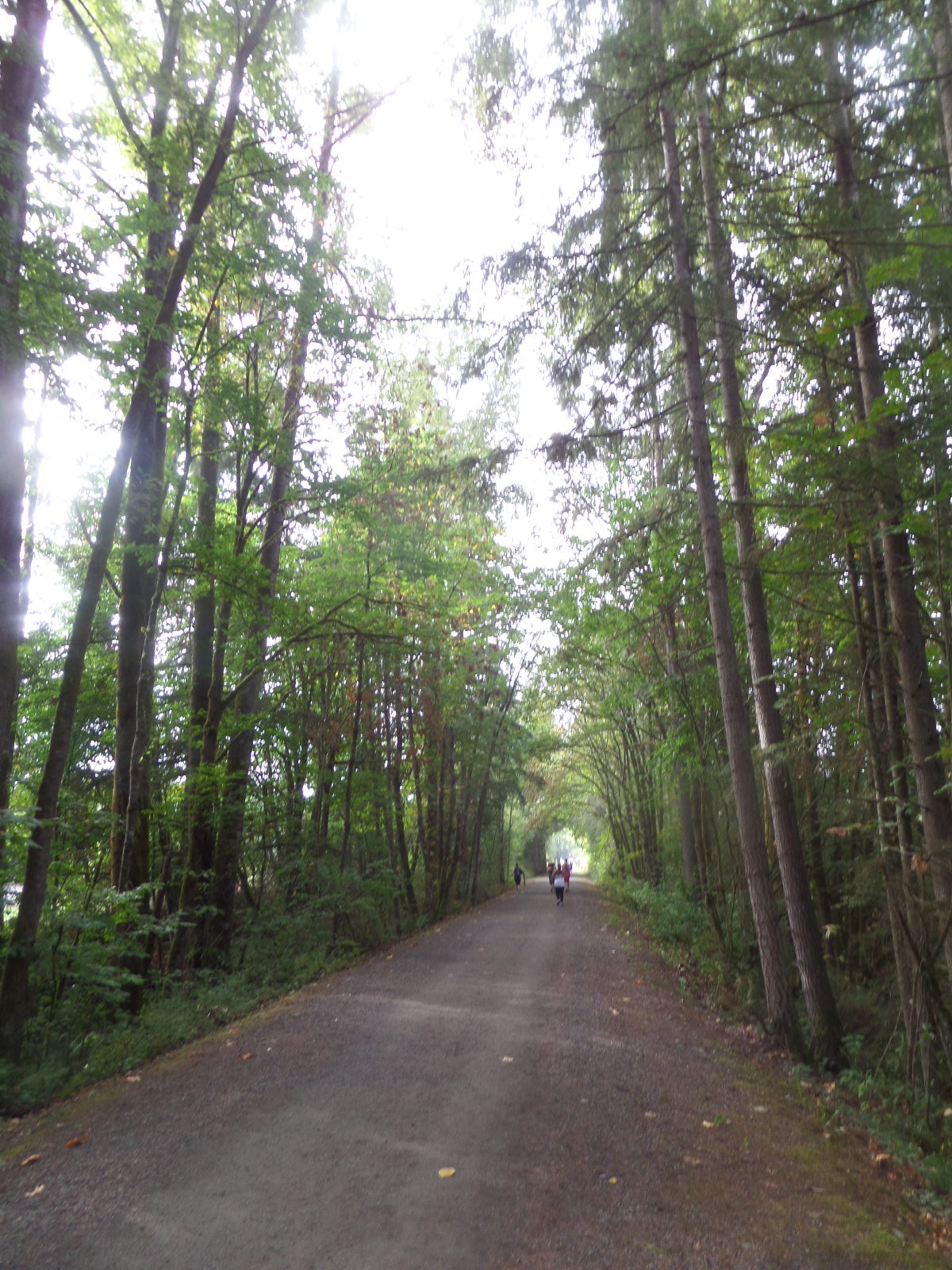
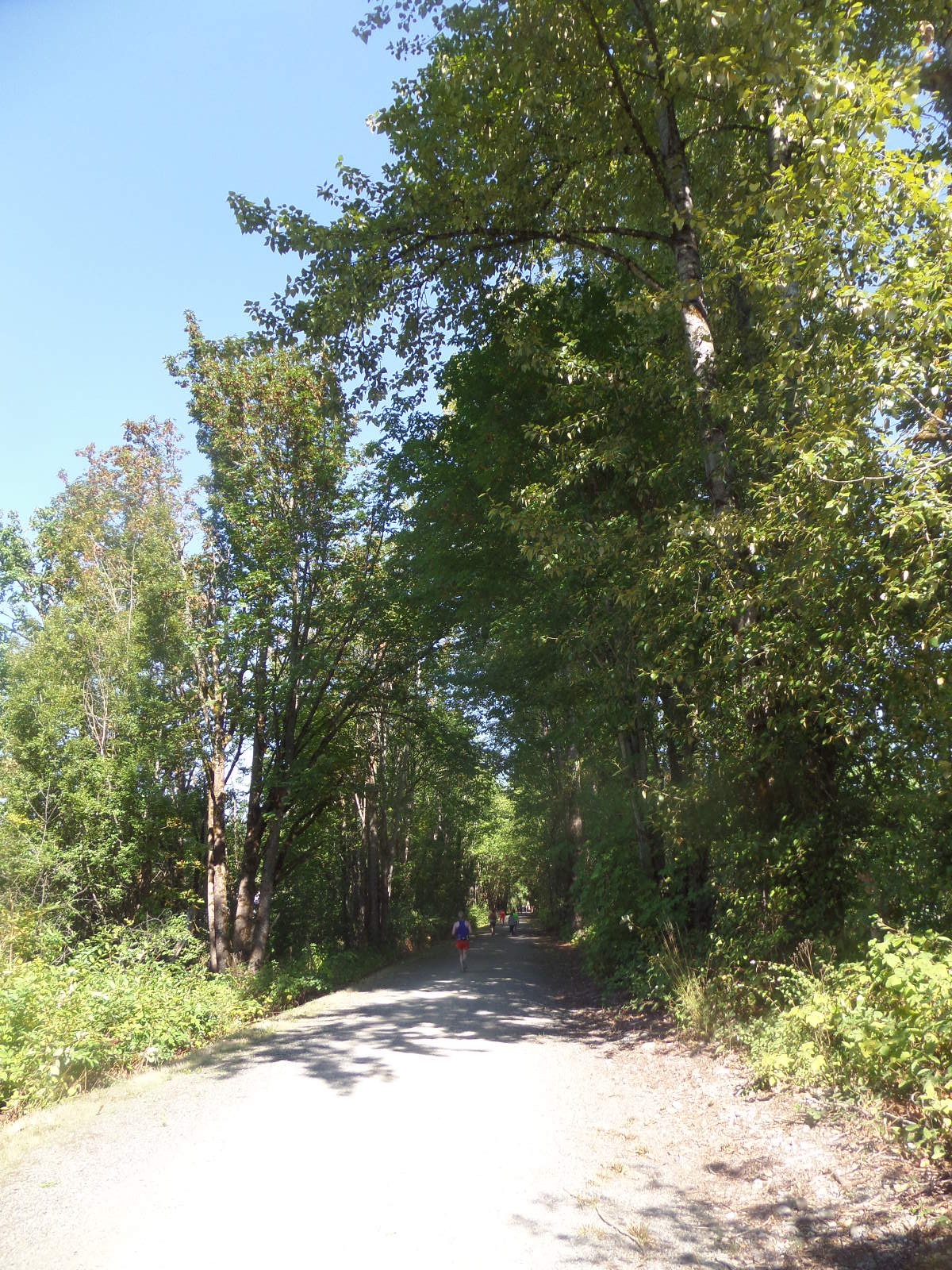
Shade on the course
Shade on the course

The trail run was pretty cool. It’s an area I’ve never run, so all new to me. There was plenty of shade, and the terrain wasn’t particularly crazy or steep. I’ve never fueled with cake, and expect most of the other runners hadn’t either. The hardest part is that the icing sticks to the inside of the dixie cups, so you have to either tear the cup open or use a clean finger to swipe the cake out. Much to my delight, I did not see piles of churdle on the trail, which means people were not over-caking themselves. (This was, by some reports, a problem last year.)

At one point I high-fived The Oatmeal himself. Naturally I had no idea who he was at the time. (“Um, why is that dude running in an inflatable green suit?) Oops. Fortunately he didn’t seem to remember when I had him sign my book after the race, or if he did he didn’t hold it against me. Probably the former, since there was a giant line of people who wanted him to sign things.


Crossing the finish line


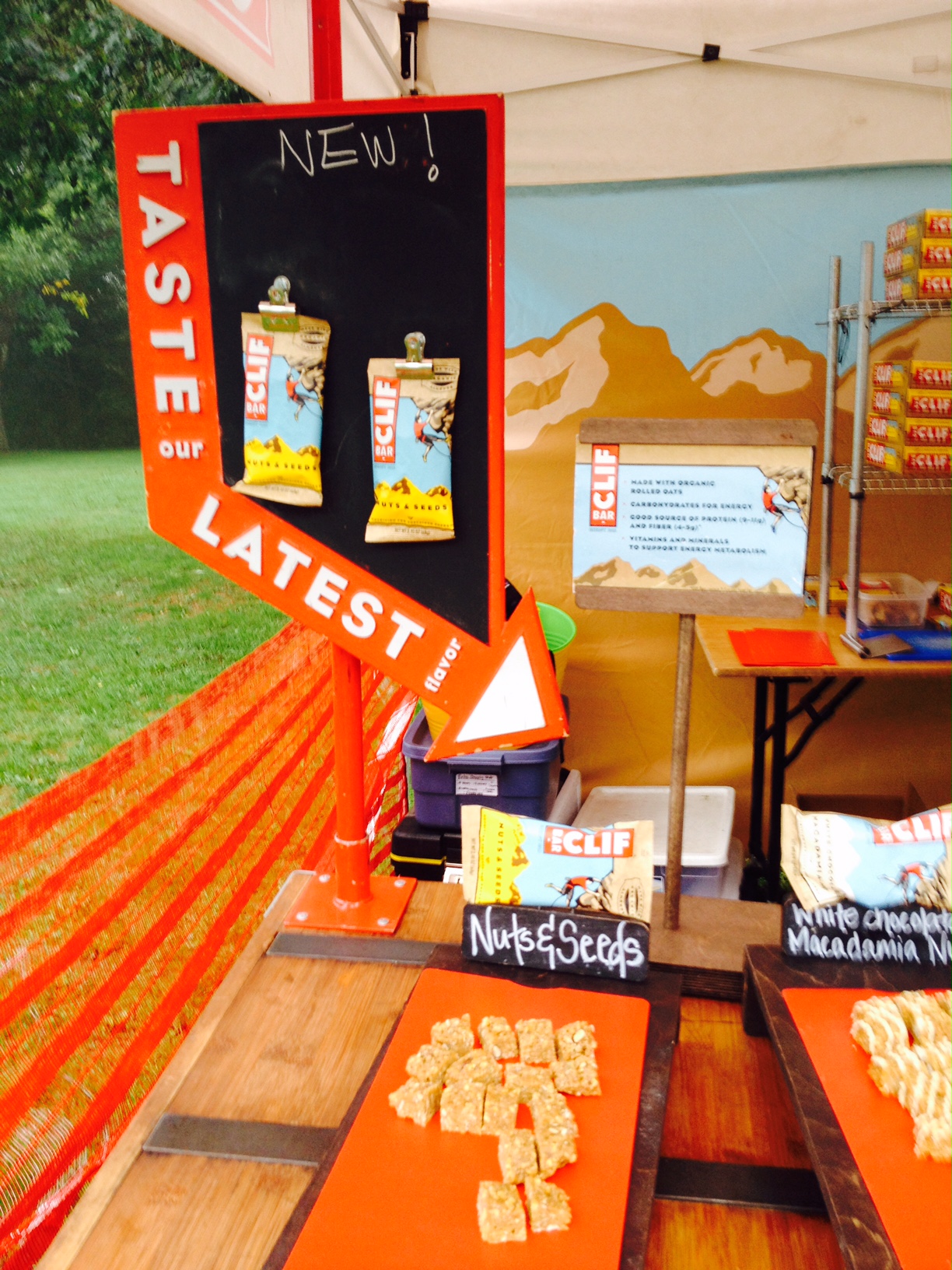
Clif Bar & Company, a little business from Emeryville, CA

The start and finish area did have a few of the normal race booths, including Clif Bars, Naked juices, etc. (but that’s not really why any of us went to Beat the Blerch). Just in case some real runners showed up an expected to see race-related types of things.


Blerch love
Blerch love


Moment of transparency, I can’t seem to get these freaking photos to behave themselves. Argh. If you happen to be reading this and are a WordPress ninja, please let me know! I need some help wrangling photos and layout, and I suspect that is going to require me to change the template (which I don’t have the mad skillz to do personally).


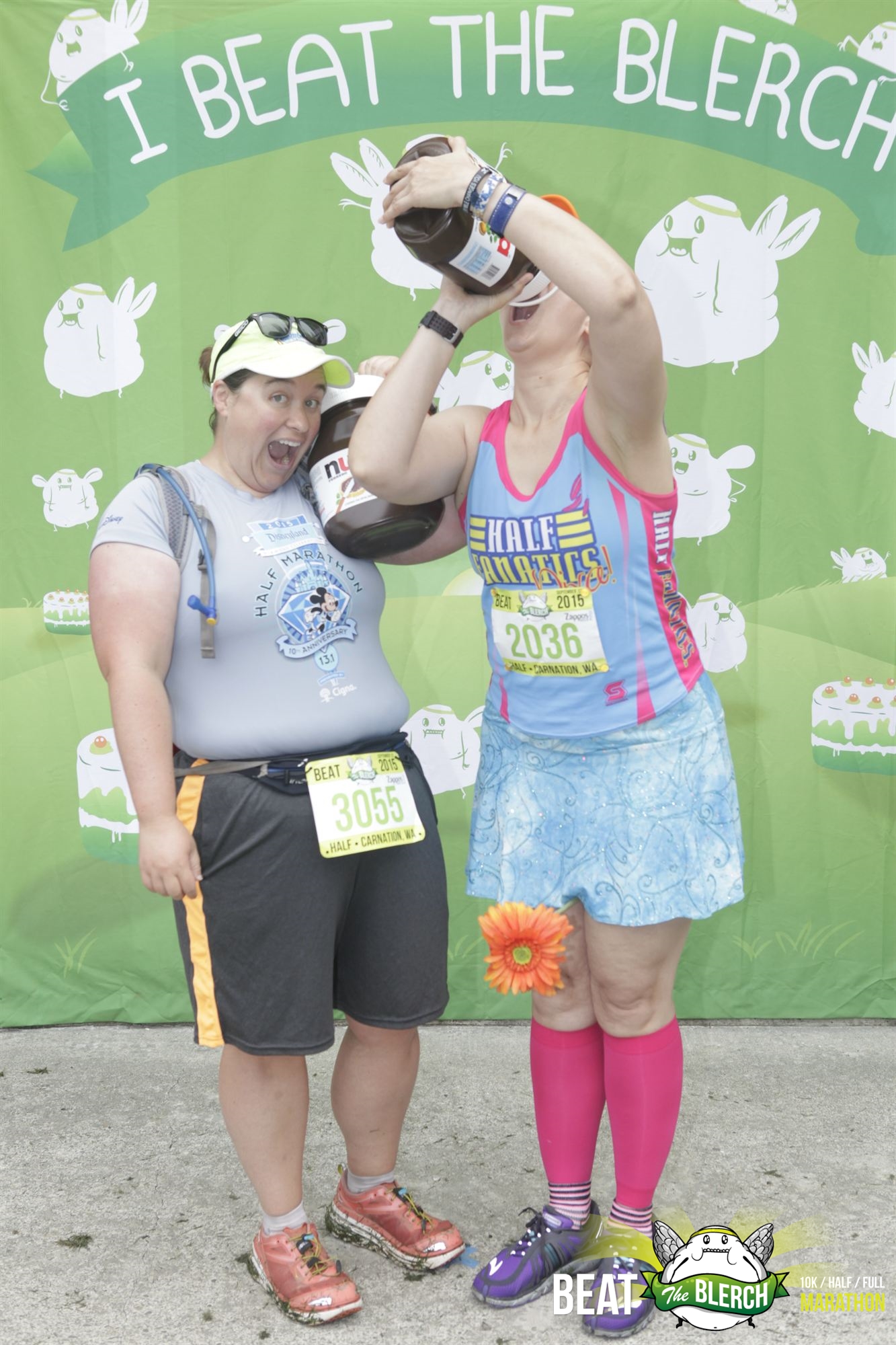
While we didn't eat directly from the buckets, there were Nutella sandwiches to be had at the aid stations and finish lines
While we didn’t eat directly from the buckets, there were Nutella sandwiches to be had at the aid stations and finish lines

We did stick around to take some photos with the absurdly large Nutella buckets. One nice perk of this race: free photo downloads. (You can also buy copies for a pretty reasonable price.)

Then it was off to Starbucks for some real coffee. I don’t know about you, but hotel breakfast buffet “coffee” doesn’t really do it for me. While waiting for the taste lattes to appear, we ducked into the restroom for a hobo bath. I am ever so thankful to Shower Pill for making this much easier–and I am sure those who shared the flight home with me were also thankful! (Shower Pill is like a baby wipe, only made for adults and intended to tide you over until you can take a real shower. The wipes are stronger than baby wipes, maybe the thickness of a washcloth, and one wipe is enough to do an entire adult body.) I’m a packing ninja, so it was a quick Shower Pill, face wash and rinse, quick pat down with a towel (you don’t need one with the Shower Pill, but I’d used regular face cleaner to do my face/neck), lotion, deodorant, and fresh clothes all around.


The sun came out, and it was a beautiful day to run

Did you run in one of the Beat The Blerch races this year? I’d love to hear what the California and New Jersey events were like!